

Can a battery reduce your facility’s peak demand without disrupting production? For UAE businesses, peak shaving battery storage UAE projects can help manage short periods of high load, but results depend on more than battery capacity. Your load profile, tariff structure, and operating requirements determine whether a system can reduce billed demand or support planned expansion.
Assessment is as important as equipment selection. A battery needs enough power to respond to a peak and enough usable energy to sustain that response for the required period. Its dispatch must also fit the facility’s operating schedule and electrical infrastructure.
This guide explains how commercial BESS supports peak shaving, what load and tariff data underpin a credible savings assessment, and what shapes system performance. It also covers the project path from load analysis and engineering through integration, testing, and commissioning. Smart Gulf Energy delivers end-to-end battery storage projects for commercial and industrial facilities, integrating systems with existing electrical infrastructure or solar PV where relevant to the facility’s operating profile.
Key Takeaways
- Peak shaving targets short periods of high demand by using stored energy to reduce how much power a facility draws from the grid.
- A commercial BESS is an integrated system of batteries, power conversion equipment, controls, protection, and a facility connection.
- Assess peak shaving battery storage UAE projects using interval load data from representative operating periods, alongside the site’s specific tariff structure.
- Battery performance depends on matching system power and energy capacity to the facility’s demand peaks and operating requirements.
- A practical project progresses from data collection and use-case modelling through engineering, integration, testing, and commissioning.
What peak shaving battery storage means for UAE commercial facilities
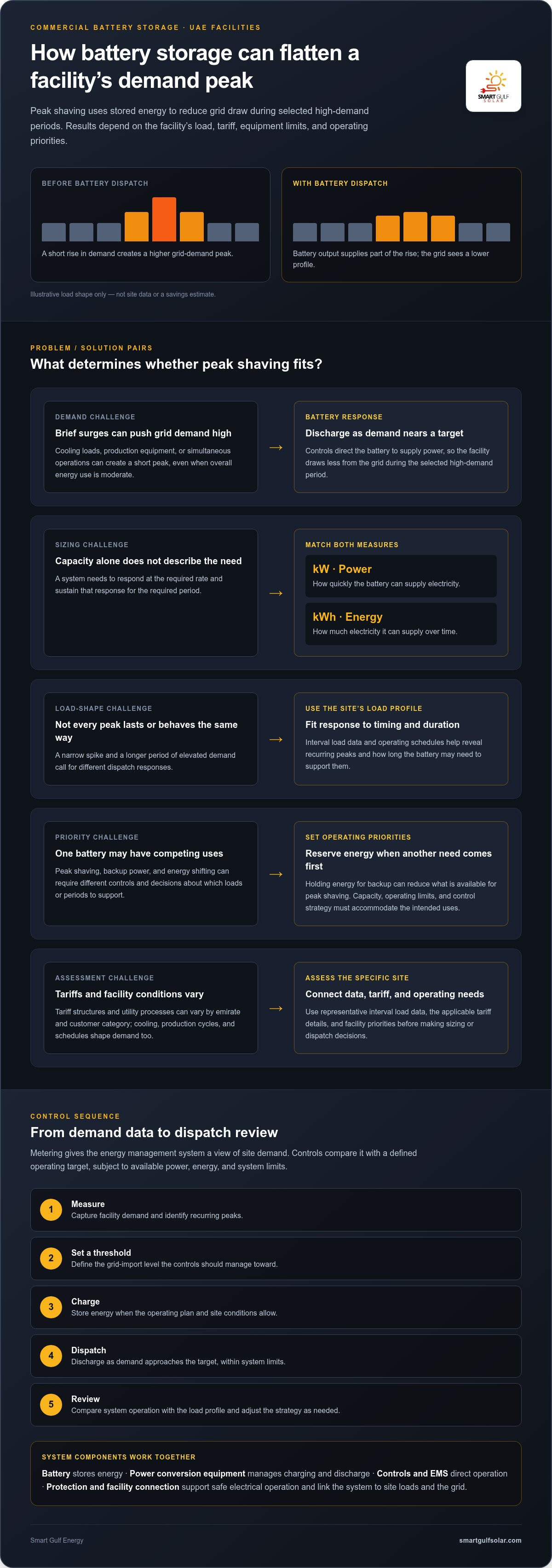
A brief surge in cooling, production equipment, or simultaneous operations can push a facility’s electricity demand to a high point, even when overall energy use is moderate. Peak shaving uses stored energy to reduce grid draw during selected high-demand periods. For peak shaving battery storage UAE projects, the aim is to shape the facility’s demand profile to suit its actual load and tariff.
Two measures guide system design. Power, measured in kilowatts (kW), describes how quickly the battery can supply electricity. Energy, measured in kilowatt-hours (kWh), describes how much it can supply over time. The system needs enough power to respond to a demand peak and enough usable energy to sustain that response for the required period.
How a battery reduces a facility’s demand peak
When facility demand is below a defined threshold, the battery can charge, subject to the operating plan. As demand approaches that threshold, controls direct the battery to discharge. While the battery is supplying power, the facility draws less from the grid, reducing the height of the grid-demand peak.
Imagine a load curve with a steady baseline and a short rise during a busy operating period. The battery’s output fills part of that rise, so the grid sees a lower, flatter profile. The shape and duration of the rise matter: a narrow spike calls for a different dispatch response than a longer period of elevated demand.
Peak shaving versus backup power and energy shifting
Peak shaving manages demand during normal grid-connected operation. Backup power prioritizes continuity when grid supply is interrupted, which can require different controls and decisions about which loads to support. Energy shifting moves electricity use between periods: the battery charges at one time and discharges later.
A single battery may support more than one objective, but only if its capacity, operating limits, and control strategy can accommodate them. Reserving energy for backup, for example, can reduce how much is available for peak shaving. Battery Energy Storage Systems (BESS) can serve different applications, but the operating plan determines which services the system can deliver at a given time.
Where UAE facility conditions enter the assessment
Cooling loads, production cycles, and operating schedules can all shape when demand rises and how long a peak lasts. The tariff matters too. Tariff structures and utility processes can vary by emirate and customer category, so assess the terms that apply to the specific site rather than assuming one UAE-wide approach.
A credible assessment connects interval load data, operating priorities, and tariff details before making sizing or dispatch decisions. For wider context, see the UAE Battery Energy Storage: Commercial BESS Guide 2026.
How a commercial battery storage system delivers peak shaving
A commercial battery energy storage system (BESS) works as a coordinated installation, not as a battery operating alone. The battery stores energy; power conversion equipment manages charging and discharge; controls direct operation; protection equipment supports safe electrical operation; and the facility connection links the system to site loads and the grid.
An energy management system (EMS) uses metering and operating settings to monitor demand and apply a dispatch strategy. The design must match the site’s demand pattern, equipment limits, and operating priorities. Usable output and discharge duration depend on the system configuration and how it is operated, including any energy reserved for other needs.
The role of the battery, inverter, and battery management system
The battery stores energy for later use. The power conversion system provides the interface for charging and supplying power to the facility. A battery management system monitors battery conditions and helps manage operation within the system’s defined limits. Protection equipment and the facility connection complete the electrical path. Component choices and configuration depend on project requirements, not a one-size-fits-all specification.
How controls coordinate dispatch with facility demand
Metering gives the controls a view of site demand, while the EMS compares that demand with a defined operating target. If demand approaches the threshold, the system can direct discharge, subject to available power and energy. State of charge matters: energy already used, or held in reserve, affects how much capacity remains for peak shaving.
Use this operating sequence as a practical guide:
- Measure: Capture facility demand and identify recurring peaks.
- Set a threshold: Define the grid-import level the controls should manage toward.
- Charge: Store energy when the operating plan and site conditions allow.
- Dispatch: Discharge as demand approaches the target, within system limits.
- Review: Compare system operation with the load profile and adjust the strategy as needed.
If backup power is also a priority, reserve settings can hold energy for outage response rather than making it available for peak shaving. Storage supports a more flexible energy system, a role described by IRENA as key technology in the world's transition. For peak shaving battery storage UAE projects, controls must reflect the facility’s actual priorities.
Peak shaving with solar PV and without solar PV
A grid-connected battery can be assessed on its own, without an on-site solar array. Where solar PV is present, generation may contribute to charging when its timing, facility demand, and system controls align. Solar output isn’t a guaranteed source of charging energy throughout the day, so the operating model should account for the site’s actual generation and load patterns.
For facilities planning a coordinated design, commercial battery storage project delivery brings system design, electrical integration, testing, and commissioning into one implementation scope.
How to assess peak shaving battery storage for a UAE site
A credible assessment starts with the facility’s operating data, not an estimated battery size. Review interval demand across representative operating periods to see when peaks occur, how long they last, and whether they repeat. An electricity bill shows total consumption, but rarely reveals the timing and shape of demand well enough to define a dispatch strategy.
For peak shaving battery storage UAE projects, tariff inputs must match the site’s emirate, customer category, and applicable contract. Review current billing records and tariff documents to identify relevant demand and time-based components before modelling project economics.
Which load and tariff data the assessment needs
Build a working dataset from interval demand, facility operating schedules, major loads, billing records, and planned operational changes. A new production line or a changed shift pattern could alter when peaks happen. Flag missing periods, inconsistent readings, or unclear tariff details before drawing conclusions about system size or financial performance.
Compare operating objectives before sizing
Peak shaving, backup power, and solar self-consumption can place different demands on the same stored capacity. Compare when discharge is needed, how much energy must be held in reserve, which control priority takes precedence, and what operational consequence follows if capacity is committed to another use. The same stored energy cannot serve two purposes at once.
Use site evidence to frame the design questions:
- Repeated demand peaks: What power output and discharge duration would be needed to manage them?
- Outage continuity requirements: Which loads matter most, and what reserve should be held?
- Solar generation and site demand: When could solar contribute to charging, and how would controls coordinate it?
- Tariff documents and bills: Which applicable demand or time-based components should the model include?
IRENA’s report on the economics of firm solar and wind provides wider context on storage and renewable-energy system design. A facility assessment still needs its own load data, operating priorities, and verified tariff inputs.
What determines a credible savings estimate
Battery savings depend on measured site demand and applicable tariff terms. A project model should account for observed peak patterns, battery capacity and power rating, dispatch limits, and the facility’s operating schedule. It should also include system efficiency, degradation assumptions, maintenance, and the full project scope.
These inputs determine how much energy can be dispatched, when it can be delivered, and how often the strategy can respond to a peak. Project economics therefore require site-specific modelling, not a generic estimate based on battery capacity alone.
From UAE site assessment to commissioned peak-shaving BESS
A peak-shaving battery project moves through defined stages. Each stage turns facility evidence into an engineered system, then verifies that the installed controls respond to the agreed operating objectives. Site electrical infrastructure, available space, equipment access, and operational requirements all shape the design.
For peak shaving battery storage UAE projects, utility approvals, interconnection arrangements, and safety requirements are project-specific. Identify and verify them against current requirements for the site rather than assuming they are uniform across every facility or emirate.
Load analysis and preliminary system design
The assessment connects interval demand and operating priorities to preliminary power, energy, and reserve requirements. Engineering also examines the facility’s electrical infrastructure, potential connection points, physical space, access for installation, and any solar PV interface relevant to the operating profile.
Make design assumptions explicit. For example, the initial model can state which demand periods it is intended to address and the operating conditions it assumes. Engineering validation then checks whether those assumptions fit the site and identifies any changes needed before final design.
Procurement, integration, and commissioning
Once the design is established, procurement and site execution bring the system components together with the facility’s electrical infrastructure. The work includes integration, control configuration, and coordination of installation activities. If solar PV is part of the project, its interface is incorporated into the system design and operating logic.
Commissioning tests the installed system against its agreed objectives. This includes checking electrical integration, control configuration, and response to the intended operating conditions. The practical sequence is: collect data, model use cases, engineer, integrate, test, and review. Do not assume a fixed savings result or approval outcome in advance.
Operating review after handover
After the system enters operation, compare actual dispatch and demand patterns with the assumptions used in design. Changes to facility schedules, production loads, or operating priorities may justify a review of control settings. Monitoring records help show how the system is responding and where adjustments may be appropriate.
A clear handover supports sound operation. It should document system configuration, control settings, operating priorities, and relevant test results, giving facility teams a practical reference for day-to-day use.
Smart Gulf Energy coordinates battery storage delivery from design and supply through electrical integration, testing, and commissioning. Explore commercial battery storage project delivery as you move from facility data to an engineered implementation plan.
How Smart Gulf Energy delivers battery storage projects for UAE facilities
A commercial battery project needs coordinated engineering and execution. Smart Gulf Energy delivers battery storage projects for commercial and industrial facilities, bringing design, supply, integration, testing, and commissioning into one project scope. Operating since 2005, the company approaches BESS as part of a facility’s electrical infrastructure, not as a standalone equipment purchase.
A project scope built around the facility’s operating objective
Peak shaving, backup power, and solar integration create different design priorities. Peak shaving focuses on managing demand during selected operating periods. Backup power gives priority to designated loads during an outage. Solar integration considers how generation, site demand, and battery controls can work together.
For each project, the system scope and control strategy are shaped by site data, existing infrastructure, and operating requirements. The design needs to reflect when the facility uses power, which loads it prioritizes, and whether stored capacity must be reserved for another purpose. There’s no single configuration suited to every commercial or industrial site in the UAE.
One delivery pathway from engineering to commissioning
Project delivery moves from engineering and procurement through construction, electrical integration, testing, and commissioning. Integration may connect the battery to existing facility infrastructure or to new solar PV where it fits the operating profile. EPC coordination aligns these stages so design decisions carry through to installation and system operation.
For facilities considering solar and storage together, the Solar EPC Contractor Dubai: The Commercial & Industrial Engineering Guide provides related context on EPC integration. A defined handover gives facility teams documentation on system configuration, control settings, and commissioning results.
Practical next steps for a facility decision-maker
Prepare the information that gives the engineering assessment a firm starting point:
- Interval load data, billing information, and facility operating schedules.
- The primary objective, such as peak shaving, backup power, or solar integration.
- Planned equipment or schedule changes that could affect future demand.
- Relevant details about the site’s electrical infrastructure and available installation space.
This information helps connect the project objective to an implementable system scope. For peak shaving battery storage UAE, the assessment should tie the control strategy to measured facility demand and the site’s operating priorities.
Smart Gulf Energy delivers battery storage projects from design through integration and commissioning. Bring your facility’s load profile and project objectives into the project discussion.
Turn facility data into a practical storage plan
Peak shaving can reduce grid demand during selected high-load periods, but system performance depends on the match between battery power, stored energy, facility operations, and the applicable tariff. A credible assessment starts with interval load data and clear priorities, whether the goal is demand management, backup power, or solar integration.
Engineering connects the operating objective to system design, electrical integration, controls, testing, and commissioning. Each decision should reflect the site’s infrastructure and actual operating profile, not a generic battery specification.
Smart Gulf Energy is a Dubai-based solar EPC contractor operating since 2005. Its end-to-end battery storage scope covers design, supply, integration, testing, and commissioning for commercial and industrial facilities. If you’re assessing peak shaving battery storage UAE for your site, bring your load data and operational priorities into the project discussion.
Discuss a commercial battery storage project with Smart Gulf Energy to start planning a system around your facility’s needs.
Frequently Asked Questions
What is peak shaving battery storage?
Peak shaving battery storage uses stored electricity to reduce the power a commercial facility draws from the grid during selected high-demand periods. The battery charges when conditions allow, then discharges when site demand approaches a defined threshold. The goal is to lower the facility’s grid-demand profile at those times. System performance depends on the site’s load pattern, tariff, operating schedule, battery design, and control strategy.
How does a battery reduce peak demand at a commercial facility?
Controls monitor facility demand and compare it with a defined target. As demand approaches that target, the battery discharges power into the facility’s electrical system, reducing the amount imported from the grid. The impact depends on how much power the battery can supply and how long the peak lasts. Metered load data helps establish when dispatch is useful and how the system should respond.
Can battery storage provide peak shaving and backup power at the same site?
Yes, a battery can be designed to support both peak shaving and backup power, but the operating strategy must account for the competing uses. Backup settings may reserve stored energy for selected loads during an outage, leaving less available for demand management. The project design should define which loads and objectives take priority, how much energy is reserved, and how controls respond under normal and outage conditions.
How is a commercial peak-shaving battery sized?
Sizing starts with interval demand data that shows the magnitude, timing, and duration of facility peaks across representative operating periods. Engineers use this evidence to estimate the required power output and stored energy, then account for operating schedules, system limits, and any reserve for backup power. Electrical infrastructure, site conditions, and the control strategy also affect the design. A single bill is not enough to size a system reliably.
Does peak shaving battery storage make sense in the UAE without solar panels?
Yes. A grid-connected battery can be assessed for peak shaving without an on-site solar array. The key inputs are the facility’s measured demand profile, operating requirements, and applicable tariff terms. Solar PV may contribute to charging if its generation timing aligns with site demand and system controls, but it isn’t a prerequisite for evaluating battery storage. Assess each project against the facility’s actual operating profile.
How much can a peak-shaving battery save a UAE business?
Savings from peak shaving battery storage UAE projects depend on measured site demand and applicable tariff terms. The assessment also needs the battery’s power and energy capacity, dispatch limits, operating schedule, system efficiency, and assumptions about degradation and maintenance. Tariff components can vary by emirate, customer category, and contract. Without those site-specific inputs, a savings figure would be a guess, not a credible project estimate.
What information is needed to assess battery storage for peak shaving?
Start with interval load data covering representative operating periods, recent bills, and the applicable tariff documentation for the facility’s emirate and customer category. Add operating schedules, major loads, planned equipment or production changes, and the site’s primary objective. Note whether backup power or solar integration is also being considered. Identify missing or inconsistent readings before using the data to make sizing or financial conclusions.


