

Battery energy storage system UAE planning should start with a facility’s operating profile, electrical infrastructure, and energy objectives, not with the biggest battery available. Should the system pair with new solar PV or connect to existing electrical infrastructure? The answer depends on how the facility uses power and what it needs storage to do.
Capacity matters, but kilowatt-hours alone do not show what a system can deliver. Power output, usable energy, controls, and electrical integration all affect performance. Commercial and industrial projects also need a defined path through engineering, approvals, construction, testing, and commissioning.
This guide explains how BESS components work together and how to compare solar-paired and grid-integrated configurations against site requirements. It covers practical considerations for projects across the UAE, including electrical integration, site operations, approvals, and system performance. Smart Gulf Energy has operated in the UAE since 2005, delivering battery storage projects from engineering and procurement through construction, testing, and commissioning. Use the guidance below to shape a project assessment around your facility’s needs.
Key Takeaways
- Understand how batteries, conversion equipment, management controls, and site loads work together.
- Compare grid-connected, solar-plus-storage, and backup-oriented options according to the job storage needs to perform.
- Use interval load data and critical-load priorities to assess suitable capacity and discharge duration for a battery energy storage system UAE project.
- Review the design considerations that affect system performance and project economics before selecting equipment.
- Plan the project from feasibility and engineering through integration, testing, and commissioning.
What a Battery Energy Storage System in the UAE Does for a Commercial Site
A commercial battery energy storage system (BESS) stores electrical energy and dispatches it when a facility needs it. The battery works with power conversion equipment and control systems to charge, discharge, and coordinate energy flows. For a foundational overview of the technology and its applications, see Battery energy storage system (BESS).
Commercial sites may use storage to back up selected loads, manage demand, integrate solar generation, or support operational resilience. These are design objectives, not automatic results. A battery energy storage system installed for a UAE business must match its load patterns, priorities, electrical infrastructure, and intended operating mode.
How commercial battery storage supports UAE operations
During an interruption, a properly designed system can supply designated equipment or circuits. Which loads it supports, and for how long, depends on system sizing, controls, and the site’s electrical design. Storage can also shift energy use or manage demand when configured for those purposes. When paired with solar PV, it can store surplus generation for later use, though the outcome depends on site conditions and system operation.
BESS terms buyers need to understand
Compare systems by both output and stored energy. A higher energy rating alone does not mean the battery can deliver more power at once.
- Rated power (kW): The rate at which the system can charge or discharge electricity.
- Usable energy (kWh): The stored energy available for the intended operation.
- Discharge duration: How long the system can deliver power at a specified output before its usable energy is depleted. It depends on both power and energy capacity.
- Round-trip efficiency: The proportion of energy put into storage that can be retrieved later, accounting for losses during charging and discharging.
Power capacity determines how much electricity a battery can deliver at once; stored energy capacity determines how much it can deliver over time. For example, a facility planning to support several critical loads should add up their power requirements and define how long they need to operate. That assessment is more useful than choosing equipment by kWh alone.
Start with the facility’s operating priorities. Then size power, usable energy, and discharge duration to meet them. This makes storage part of the site’s infrastructure rather than a standalone equipment purchase.
How a UAE Battery Energy Storage System Integrates with Solar and the Grid
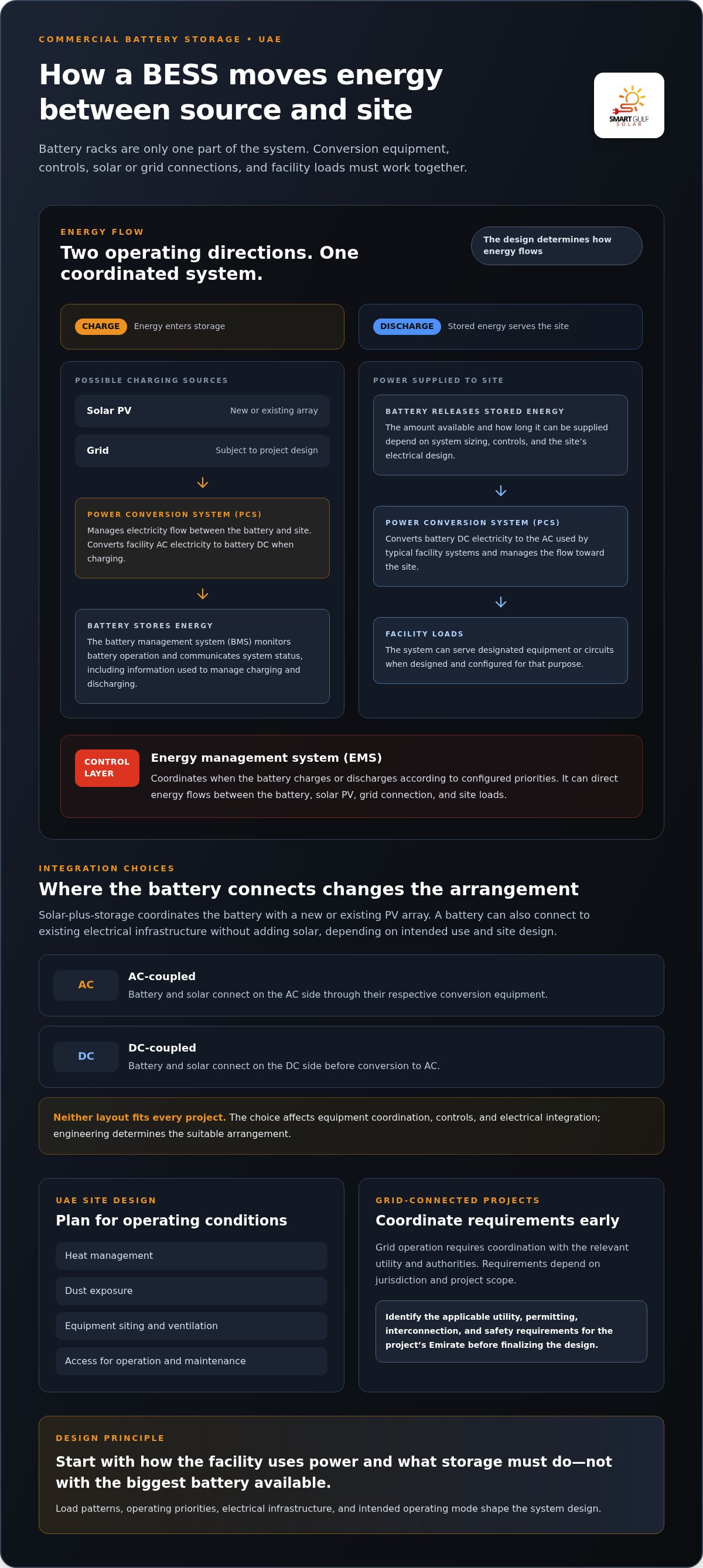
A battery system is more than battery racks connected to a building. Its power conversion system, controls, site electrical infrastructure, and loads must work as a coordinated arrangement. Whether the battery charges from solar PV, the grid, or both depends on the project design and operating priorities.
What the core BESS components do
The battery stores energy. The battery management system (BMS) monitors battery operation and communicates system status, including information used to manage charging and discharging. The power conversion system (PCS) manages the flow of electricity between the battery and the site. It converts the battery’s direct current to the alternating current used by typical facility systems, and converts electricity in the other direction when charging.
The energy management system (EMS) coordinates when the battery charges or discharges according to configured priorities. It can direct energy flows between the battery, solar PV, grid connection, and site loads. Together, these components determine how a battery energy storage system UAE project interacts with a facility, not just how much energy the battery can store.
Solar-coupled versus grid-connected battery storage
A solar-plus-storage system coordinates the battery with a new or existing PV array. A battery connected to existing electrical infrastructure can operate without adding solar, depending on the intended use and site design. Both arrangements require integration with the facility’s electrical system and a plan for how energy should flow during normal operation and a disruption.
AC- and DC-coupled layouts describe where the battery connects relative to solar generation and conversion equipment. In an AC-coupled design, the battery and solar system connect on the AC side through their respective conversion equipment. In a DC-coupled design, they connect on the DC side before conversion to AC. The choice affects equipment coordination, controls, and electrical integration. Neither layout is right for every project; engineering determines the suitable arrangement.
Grid-connected operation also requires coordination with the relevant utility and authorities. Requirements and processes depend on the project’s jurisdiction and scope. Dubai DEWA processes are location-specific, so identify the applicable utility, permitting, interconnection, and safety requirements for the project’s Emirate before finalizing the design.
Plan for the UAE operating environment during design. Heat management, dust exposure, equipment siting, ventilation, and access for operation and maintenance all affect system layout. Treat these as engineering inputs, not afterthoughts. For broader context on storage economics and renewable integration, consult IRENA’s analysis of storage costs. Project decisions still need to reflect current site conditions and design requirements.
Compare Commercial BESS Configurations for UAE Sites and Operating Needs
Choose a configuration based on the job the battery needs to perform, then test it against the facility’s load profile, electrical infrastructure, and operating schedule. A grid-connected system, solar-plus-storage arrangement, or backup-oriented design can address different priorities. As IRENA’s overview of battery electricity storage technology explains, storage supports a range of applications, but the right setup depends on how a site will use it.
| Operating priority | Configuration focus | Key design consideration |
|---|---|---|
| Backup | Battery integrated with site electrical infrastructure and configured to supply selected loads during an interruption | Define essential circuits and required operating duration. Backup coverage depends on system design and load. |
| Peak management | Grid-connected storage controlled to discharge at selected times | Controls must align with demand patterns and the facility’s operating priorities. |
| Solar self-consumption | Solar PV paired with storage to shift some generated energy for later use | Compare solar production timing with daytime loads and site schedules. |
| Combined use | Storage configured for more than one objective, such as solar shifting and backup | Priorities may compete for available power and energy, so define the operating strategy in advance. |
These are starting points, not fixed equipment packages. A battery energy storage system for a UAE facility should reflect the required controls, integration work, and operating objectives. Combined use can serve more than one purpose, but it requires clear rules for allocating stored energy.
When solar-plus-storage suits a commercial facility
Compare the site’s solar production curve with its daytime demand and operating hours. If generation exceeds immediate loads at certain times, storage may shift some solar energy for later use, subject to system design. If solar output already aligns with facility demand, the battery may have a different role. Model generation and consumption together instead of sizing the battery in isolation.
When backup or load management is the primary objective
Start by separating essential loads from total site demand. A facility may need to support selected equipment rather than its entire operation during an interruption. For load management, identify when demand rises and how the battery’s controls should respond. Backup duration depends on usable capacity, connected load, controls, and operating conditions. A detailed peak-shaving or critical-power design also needs a close review of site data and electrical arrangements.
Define the primary objective first, then assess secondary uses against the same operating plan. This keeps configuration decisions grounded in facility requirements rather than generic claims about what storage can do.
How to Evaluate BESS Capacity, Performance, and Project Economics in the UAE
A sound BESS assessment starts with how the facility uses electricity, not with a target battery size. Gather interval load data, operating hours, critical-load requirements, and the intended use, such as solar energy shifting, load management, or resilience. For a battery energy storage system UAE project, connect those operating needs to a defined technical and financial case.
A practical sequence for screening BESS size
Build a working dataset from utility bills, interval consumption data, solar production records where available, and operating schedules. Identify priority loads, the periods when storage should operate, and any resilience objectives. Then model candidate power and energy capacities against each scenario. Check whether the system can deliver the required output for the necessary duration.
Keep the sizing terms distinct. Power, measured in kW, addresses the load the battery must serve at a given moment. Usable energy, measured in kWh, and required discharge duration determine how long it can serve that load. A high energy rating alone does not establish that the system can meet the site’s peak power requirement.
What a credible commercial assessment should include
Make the assumptions visible. The assessment should state expected round-trip efficiency, usable capacity, operating cycles, operating limits, degradation assumptions, and any equipment replacement considered over the evaluation period. It should also account for integration, commissioning, controls, and ongoing operating requirements, rather than treating the battery as an isolated equipment cost.
Compare lifecycle value against a clearly defined operating case. Set out the charging and discharge schedule, the facility loads served, and the applicable energy and billing assumptions. Avoid generic payback promises: results depend on site data, system performance, project scope, and the commercial assumptions used. A BESS is not automatically economical; its value must be demonstrated against a real operating objective.
Size storage from measured load data and operating objectives, then select power, usable energy, and duration to meet that defined case. This ties the design to facility requirements and makes the economics easier to assess and revise if assumptions change.
Smart Gulf Energy coordinates BESS engineering, procurement, construction, integration, testing, and commissioning for commercial and industrial projects. Learn more about its services at Smart Gulf Energy.
From BESS Feasibility to Commissioning: Delivering a UAE Storage Project
A defined operating case is the starting point. Delivery then follows a controlled sequence: assess the site, engineer the system, procure equipment, construct, integrate, test, and commission. Each stage connects the battery design to the facility’s electrical infrastructure, operating requirements, and solar PV if it is part of the project.
Engineering and procurement before construction
Site assessment establishes existing electrical conditions, load requirements, equipment locations, and integration needs. Engineering translates those findings into a system architecture, equipment specifications, control strategy, and construction plan. If solar PV is included, the design must coordinate generation and storage with the site’s electrical systems. For related context, see this solar EPC contractor Dubai engineering guide.
Procurement should follow the engineered requirements. Equipment selection, controls, and interfaces need to align with the project design rather than being treated as separate purchasing decisions. A single EPC scope can coordinate these workstreams and manage handoffs between equipment supply, site construction, and electrical integration.
Plan authority submissions and grid interconnection around the project’s location and scope. Utility coordination, approvals, safety, and fire protection requirements can vary by jurisdiction and project. Identify the applicable process early and carry those requirements into engineering and delivery planning.
Integration, testing, and commissioning
Construction prepares the site and installs the equipment. Integration connects the battery and power conversion equipment with the facility’s electrical infrastructure, solar PV where included, and control systems. The team configures controls around the project’s operating priorities and coordinates the system interfaces.
Testing checks that equipment, controls, and electrical connections operate as designed. Commissioning verifies system operation against project-specific design and acceptance criteria before the system enters operation. This stage confirms that the installation matches the agreed project requirements, not just the equipment specifications.
Smart Gulf Energy delivers commercial and industrial BESS projects through engineering, procurement, construction, integration, testing, and commissioning. Its systems can connect to new solar PV or existing electrical infrastructure. Discuss your commercial battery energy storage system UAE requirements with Smart Gulf Energy to plan a practical path from feasibility to commissioning.
Turn Your Storage Strategy into a Deliverable Project
A commercial BESS project starts with clear operating priorities. Match the configuration to site loads, decide whether storage will work with solar PV or existing electrical infrastructure, and assess capacity against real operating data. Then carry the design through engineering, approvals, procurement, integration, testing, and commissioning.
This sequence helps make a battery energy storage system part of a facility’s electrical infrastructure rather than simply an equipment purchase. A well-defined design connects performance expectations with site requirements and a clear delivery scope.
Smart Gulf Energy is a UAE-based EPC contractor operating since 2005. The team designs, supplies, integrates, tests, and commissions commercial battery storage projects, coordinating systems with existing electrical infrastructure or new solar PV.
With operating priorities clear and delivery stages aligned, your facility can move forward with a practical project plan. Discuss your commercial battery storage project with Smart Gulf Energy.
Frequently Asked Questions
What is a battery energy storage system?
A battery energy storage system stores electricity and dispatches it when a site needs it. It combines battery equipment with a power conversion system and controls that manage charging, discharging, and energy flows. Commercial systems can support objectives such as backup for selected loads, load management, and solar energy use. The design must match the facility’s electrical infrastructure and operating priorities; battery capacity alone does not define what the complete system can do.
How does a commercial BESS work with solar panels?
A commercial BESS can store electricity generated by solar panels and supply some of that energy later, depending on the system design. The energy management system coordinates charging and discharging with solar generation and site demand. The fit depends on when the facility uses power relative to when the panels generate it. AC- and DC-coupled layouts connect the systems differently, so engineering needs to account for the equipment, controls, and electrical interfaces.
Can a battery energy storage system provide backup power?
Yes, a BESS can provide backup power to selected loads if its electrical design and controls support backup operation. Start by identifying critical equipment and its power requirements rather than assuming the battery can serve the entire facility. Backup duration depends on usable stored energy, connected load, system controls, and operating conditions. The design should specify which circuits receive backup and the operating objective they need to meet.
How much battery capacity does a commercial site need?
Capacity depends on the site’s load profile and intended use for storage. Review interval consumption data, operating schedules, critical loads, and required discharge duration. Size power in kilowatts (kW) to meet the required output at a given moment, and usable energy in kilowatt-hours (kWh) to support that output over time. A battery’s kWh rating alone does not show whether it can meet a facility’s power requirement.
Is a battery energy storage system worth it in the UAE?
A battery energy storage system UAE project can be worthwhile when a defined operating case supports its lifecycle value. Assess how the system will be used, what loads or energy flows it will serve, and how performance assumptions affect the analysis. Include usable capacity, efficiency, operating cycles, integration, commissioning, and operating requirements. Do not assume a fixed payback; project economics depend on site data, system design, and the assumptions used.
What happens if a BESS is installed in a hot or dusty UAE location?
Address heat and dust in the project’s engineering and equipment-siting plan. Design decisions need to account for thermal management, ventilation, exposure, equipment location, and access for operation and maintenance. If environmental conditions are overlooked, they may affect system operation and the demands placed on its equipment. A site-specific assessment helps inform the installation arrangement and environmental design measures for the project.
How long does a commercial BESS project take to deliver?
There is no single delivery timeline for every commercial BESS project. Duration depends on the site, project scope, engineering and procurement requirements, construction and integration work, and applicable approvals or interconnection processes. Delivery typically progresses through assessment, engineering, procurement, construction, integration, testing, and commissioning. Establishing project requirements and applicable authority processes early helps create a realistic delivery plan.


