

What if the right backup plan starts with less than the whole building? For a battery backup system commercial UAE operators need to identify which critical loads must stay online, and for how long. Battery capacity alone won’t answer that. Runtime, power demand and integration with existing electrical infrastructure or solar PV must be engineered together.
It’s reasonable to compare batteries with UPS units and generators, especially when continuity is at stake. But these systems serve different roles. A battery can support selected loads for a defined runtime. The right design depends on the site’s operating requirements, load profile and electrical setup.
This guide explains how to define critical loads, set a realistic backup requirement and compare battery, UPS and generator functions. It also outlines the UAE project pathway, from load analysis and system design through applicable approvals, installation, testing and commissioning. Smart Gulf Energy provides end-to-end commercial battery storage project delivery, including design, supply, integration, testing and commissioning.
Key Takeaways
- Separate backup power from peak shaving, energy shifting and solar self-consumption so the system is designed for its intended job.
- A battery backup system commercial UAE project must account for both usable energy and the power needed to run selected equipment.
- UPS units, battery storage and generators serve different roles. Combining them can support separate layers of site resilience.
- Build a project brief around your site, priority equipment, existing electrical or solar assets and operating needs to guide design through commissioning.
What Does a Commercial Battery Backup System in the UAE Actually Protect?
A commercial battery backup system stores energy and supplies selected site loads when normal power is interrupted. The defining decision isn’t the headline battery capacity. It’s which operations must continue, what they require electrically and how long they need support.
Backup power has a different job from other battery applications. Peak shaving reduces demand drawn from the grid during high-use periods. Energy shifting stores power for use later, while solar self-consumption uses stored solar generation on site. A system may be designed for one or several of these functions, but each objective changes the operating priorities and design requirements.
For a battery backup system commercial UAE project, the site’s electrical arrangement and location shape the design. Integration with existing infrastructure or solar PV, along with applicable authority coordination, must be assessed for the specific project. Approval requirements depend on the site and system configuration.
Which commercial loads should receive backup power?
Start with an equipment-level load schedule. Group circuits by safety, operational importance and acceptable interruption duration. Emergency lighting, control systems, communications, refrigeration and selected production equipment may have different continuity needs depending on the facility.
Separate essential circuits from equipment that can shut down safely. Some processes need immediate continuity; others can tolerate a pause or restart after power returns. Record each load’s priority, electrical demand and acceptable interruption. This gives the engineering team a practical basis for defining protected loads instead of sizing storage for the entire facility by default.
How is battery backup different from a UPS or generator?
A Uninterruptible Power Supply (UPS) typically protects selected sensitive loads and helps maintain continuity through a power disturbance or interruption. A battery energy storage system can support a broader set of selected circuits, subject to its configuration and available energy. A generator provides another source of power, with its role determined by the site design and operating plan.
These technologies aren’t automatic substitutes. A UPS may protect controls while a battery system supports defined facility loads; a generator may add another layer to the resilience plan. Transfer behavior, supported circuits and runtime depend on the engineered arrangement. Define the required outcome first, then assign each component a clear role.
How UAE Commercial Battery Backup Systems Are Sized and Integrated
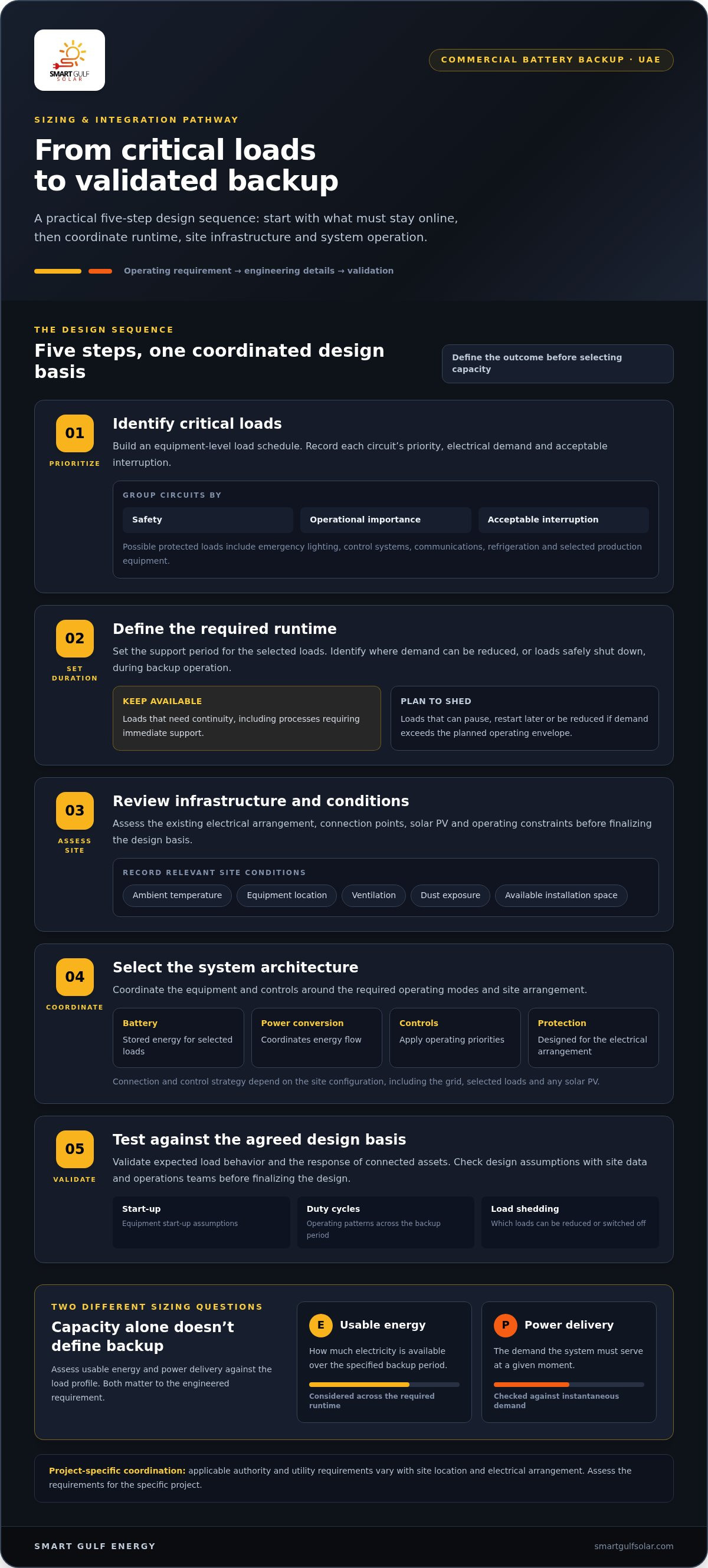
A sound design starts with the operating requirement, then works through the electrical details. For a battery backup system commercial UAE project, coordinate protected loads, runtime, site infrastructure and controls rather than selecting a battery by capacity alone.
- Identify critical loads. List the equipment and circuits that must remain available, along with their electrical demand and priority.
- Define runtime. Set the required support period and identify any stages where loads can be reduced or shut down.
- Assess site infrastructure. Review the existing electrical arrangement, connection points, solar PV and operating constraints.
- Select the system architecture. Coordinate the battery, power conversion equipment, controls and electrical protection around the required operating modes.
- Validate operation. Test the system against the agreed design basis, including expected load behavior and the response of connected assets.
Battery energy and power delivery answer different questions. Usable energy relates to how much electricity is available over the specified period. Power delivery relates to the demand the system must serve at a given moment. Assess both against the load profile. Neither can be determined from a headline capacity figure alone.
How do critical load and backup duration shape system design?
Build the design basis from operating priorities and a load profile. Separate instantaneous demand from the total energy required over the backup period. Document assumptions about equipment start-up, duty cycles and which loads can be shed if demand exceeds the planned operating envelope. Validate those assumptions with site data and operations teams before finalizing the design.
UAE site conditions also matter. Ambient temperature, equipment location, ventilation, dust exposure and available installation space can affect equipment selection and layout. Record these conditions and operating assumptions explicitly in the project design basis.
How does a battery system connect to existing power or solar PV?
The system connects through the site’s electrical infrastructure. Power conversion equipment and controls coordinate how energy moves between the battery, selected loads, the grid and any solar PV. An energy management system can apply the project’s operating priorities across these assets. The commercial BESS guide for the UAE provides wider system context.
This coordination is part of the broader role of battery storage in the energy transition, which includes storing energy and supporting power-system needs. The operating strategy and interface depend on the site configuration. Authority and utility coordination also vary by project location and electrical arrangement, so identify the requirements for the specific site rather than assuming one route applies across the UAE.
Smart Gulf Energy delivers commercial battery storage projects from design and supply through integration, construction, testing and commissioning. To discuss your site’s loads and existing assets, explore Smart Gulf Energy’s project capabilities.
Battery, UPS, or Generator: Comparing Commercial Backup Options in the UAE
These technologies solve related but different power problems. A UPS can bridge an interruption for sensitive equipment. Battery energy storage can support selected site loads according to its power and energy design. A generator can provide another source for extended operation, depending on fuel, controls and site configuration.
| Option | Response role | Supported loads | Runtime planning | Integration and operating use |
|---|---|---|---|---|
| UPS | Maintains continuity for selected equipment through power disturbances or transfer events. | Sensitive or critical circuits, as configured. | Based on the protected load and required bridging period. | Often positioned close to the equipment or circuit it protects. |
| Battery energy storage | Supplies stored energy to selected loads under defined operating conditions. | Circuits included in the engineered system. | Planned around usable energy, load demand and operating priorities. | Can coordinate with site power and solar PV where the design supports it. |
| Generator | Provides a separate power source during an interruption. | Loads served by the generator and transfer arrangement. | Depends on system design, operating conditions and fuel arrangements. | May form a longer-duration layer in a wider resilience plan. |
A battery system isn’t automatically a whole-site or long-duration replacement for a generator. Its limits depend on the protected circuits, available energy, power demand and operating strategy. UPS equipment, batteries and generators can instead serve distinct layers, from sensitive controls to selected facility loads and additional generation.
When is battery storage the right fit for commercial backup?
Battery storage fits a defined requirement: selected loads, a clear operating profile and a workable connection to the site’s electrical infrastructure. Solar PV may be part of the design when the site arrangement and operating objective support that pairing. Transfer behavior and continuity depend on the engineered system, so verify them against the design requirements rather than assuming uninterrupted operation. A global overview of electricity storage gives wider context for the technology.
How can battery backup work alongside peak shaving?
Backup and peak shaving are separate objectives, even when one battery system is designed to support both. Controls must balance peak-demand dispatch against the energy reserve required for backup. If resilience takes priority, the operating strategy may preserve capacity. If demand management leads, dispatch may use stored energy at other times. The UAE peak shaving battery storage guide explains that distinct demand-management use case.
For a battery backup system commercial UAE project, lifecycle and project economics depend on site-specific assumptions, including operating objectives and system configuration. Smart Gulf Energy integrates commercial battery storage with existing infrastructure or solar PV as part of an end-to-end project scope. Explore commercial battery storage project delivery.
Inside a UAE Commercial Battery Backup Project: Case Study Framework
A useful case study shows how a defined site requirement became an engineered and tested system. Keep documented project facts distinct from general explanation. If describing a hypothetical scenario, label it clearly as illustrative rather than presenting it as a completed client project.
For a battery backup system commercial UAE project, a credible account should trace the work in sequence:
- Site challenge: Describe the facility context and continuity issue, using details approved for publication.
- Design basis: Identify the loads selected for backup, runtime requirement, existing electrical arrangement and any solar PV interface.
- Engineering choices: Explain the system configuration and constraints recorded in project documents.
- Delivery: Summarize engineering, procurement, construction, testing and handover.
- Measured outcome: Report commissioning results or operational performance only when supported by records and approved for publication.
What should a credible commercial backup case study document?
Keep the evidence trail clear. Record the facility context, protected circuits, documented design assumptions and integration constraints. Then connect each engineering choice to the site requirement it addressed. Commissioning tests and outcomes should reflect actual records, not projected performance. Obtain permission for client identity and project details before including them, and leave out sensitive information that isn’t approved for release.
Project coordination is site-specific in the UAE. The relevant emirate, facility type, utility interface and electrical arrangement inform the coordination and approval pathway. A case study should state what applied to that project without implying the same route governs every site.
How does EPC delivery move from design to commissioning?
Delivery typically progresses from site assessment and engineering into procurement, construction, integration, testing and handover. At each stage, the project team aligns scope, interface points, responsibilities and required records. Where solar PV forms part of the system, coordinate its electrical interface and control strategy with the battery design. The commercial solar EPC engineering guide offers related context.
Smart Gulf Energy delivers commercial battery storage projects through design, supply, integration, construction, testing and commissioning. Discuss your commercial battery storage project with the team.
Plan Your Commercial Battery Backup Project with a UAE EPC Partner
A clear project brief turns an operational concern into an engineering scope. For a battery backup system commercial UAE project, start with the site requirement: what must stay powered, for how long and how the system should work with existing electrical assets.
What information should a business prepare for project scoping?
Bring information that shows how the facility operates. Available drawings, load data and operating schedules help establish the site’s electrical arrangement and demand patterns. Note any gaps in the records so they can be addressed during assessment.
- Site: Identify the facility location, site type and practical installation constraints.
- Critical loads: List priority equipment and processes, their demand, and which circuits can shut down safely.
- Runtime: Define the required backup period and acceptable interruption limits for each priority.
- Existing assets: Provide information on electrical infrastructure, UPS equipment, generators and solar PV, where present.
- Operating priorities: Describe the intended backup scenario, load-shedding approach and any other planned battery uses.
Be specific about the outcome. A site aiming to maintain controls through a short interruption has a different brief from one seeking to support selected operating loads for a defined period. Clear priorities help shape a design around the requirement, rather than assuming every circuit needs the same level of support.
What happens after the initial project brief?
Smart Gulf Energy develops commercial battery storage projects through a coordinated EPC sequence: site assessment, engineering, procurement, construction, integration, testing and commissioning. The technical design and project scope are tailored to documented site requirements, including interfaces with existing electrical infrastructure or solar PV.
Project coordination also reflects the facility’s emirate, site type, electrical configuration and relevant utility or authority requirements. Establish the applicable pathway for the specific project instead of assuming it is identical across the UAE. Clear scope, interface points and responsibilities carry through delivery to testing and handover.
Bring your site information, priority loads and operating objective into the first project discussion. Discuss a commercial battery backup project with Smart Gulf Energy.
Build Your Backup Plan Around the Loads That Matter
A reliable commercial backup design starts with operational priorities, not a headline battery capacity. Identify the circuits that must stay online, define a realistic runtime and assess how battery storage will work with existing electrical infrastructure, solar PV, UPS equipment or generators. Each serves a distinct role, and the right combination depends on the site.
For a battery backup system commercial UAE project, engineering, integration and site-specific authority coordination need to move together. Smart Gulf Energy is a Dubai-based EPC contractor operating since 2005, delivering commercial battery storage design, supply and integration through construction, testing and commissioning.
Bring your site details, critical loads and operating priorities into the next step. Discuss your commercial battery backup project with Smart Gulf Energy and turn the requirement into a defined project pathway.
Frequently Asked Questions
What is a commercial battery backup system?
A commercial battery backup system stores electricity and supplies selected site loads when normal power is interrupted. It may support priority circuits rather than the entire facility, depending on operational requirements and electrical design. Its purpose can be backup, peak shaving, energy shifting or a combination, but these objectives require coordinated controls and clear design assumptions. Define what must remain available before selecting system capacity.
How long can a commercial battery backup system run?
Runtime depends on usable battery energy, the power drawn by connected loads and how the system is configured to operate. A facility supporting only essential controls may have a different runtime requirement from one backing up selected production equipment. Load changes, equipment start-up and planned load shedding also matter. Set the required backup period and protected circuits first, then size and validate the system against that operating scenario.
Can a commercial battery system replace a UPS or generator?
Not automatically. A UPS typically supports selected sensitive equipment through power disturbances or interruptions. Battery energy storage can supply configured site loads, while a generator may provide another power source for a different operating role. These systems can complement one another in a resilience plan. Whether a battery can meet a specific continuity requirement depends on its design, transfer behavior, available energy and load profile, not simply on the presence of storage.
How do you size a battery backup system for a commercial building?
For a battery backup system commercial UAE project, begin with a load schedule that identifies priority circuits, their demand and acceptable interruption limits. Define the target runtime and assess the electrical infrastructure, operating profile and any solar PV connection. Usable energy determines how much electricity is available over time; power capability addresses demand at a given moment. Validate assumptions about start-up loads and load shedding before finalizing the design.
Can a commercial battery backup system integrate with solar panels in the UAE?
Yes. A commercial battery system can be designed to integrate with existing or new solar PV when the site configuration and operating objective support it. The system’s power conversion equipment and controls coordinate how the battery interacts with solar generation, site loads and electrical infrastructure. The design should account for intended operating modes and project-specific site conditions. Integration and related coordination depend on the facility’s electrical arrangement and location.
What approvals are needed for commercial battery storage in the UAE?
Approval and utility coordination depend on the project’s emirate, site type, system configuration and interaction with the electrical network. Don’t assume one route applies to every UAE project. During project development, identify the relevant authority and utility requirements for the specific site and coordinate the design accordingly. The scope of review can depend on how the battery connects to existing infrastructure and whether solar PV or other assets are part of the system.
What should a commercial battery backup case study include?
A credible case study documents the facility context, the specific loads selected for backup, the design basis and relevant integration constraints. It should describe delivery stages and report commissioning tests or performance outcomes only when project records support those claims and publication is approved. Avoid unsupported figures for capacity, runtime or savings. If a completed project example isn’t available for publication, label the account clearly as an illustrative scenario rather than presenting it as a client installation.


