
A commercial solar installation UAE project is an engineered industrial asset, not an off-the-shelf equipment purchase. Approaching commercial rooftop generation as a simple hardware procurement exercise frequently leads to structural liabilities, permitting gridlocks, and compromised energy yield.
Enterprise operators recognize the mounting burden of peak utility tariffs during operational daytime hours. You also understand the technical friction that threatens project delivery: bureaucratic delays during utility approvals, extreme ambient heat degrading module performance, and structural roof work that risks facility downtime.
This operational blueprint details the exact engineering, regulatory compliance, and procurement phases required across Dubai and the wider UAE. You'll learn how to secure certified utility approvals without administrative bottlenecks, protect your facility from operational disruption, and deploy heat-resilient generation assets under single-source EPC accountability.
The following sections outline the technical roadmap from initial load engineering and utility filings to physical installation and grid synchronization.
Key Takeaways
- A turnkey commercial solar installation UAE framework secures predictable operational expenditure reduction while safeguarding structural roof integrity.
- Advanced thermal engineering and equipment selection prevent severe power degradation during peak Arabian summer ambient heat conditions.
- Rigorous utility alignment under the DEWA Shams Dubai framework eliminates administrative bottlenecks and fast-tracks connection approvals.
- Single-source EPC execution transfers design, structural engineering, and grid compliance liabilities away from enterprise facility operators.
- Standardized commissioning protocols and plant performance tests verify baseline energy yields before commercial energization.
Commercial Solar Installation UAE: Engineering Scope and Industrial Value
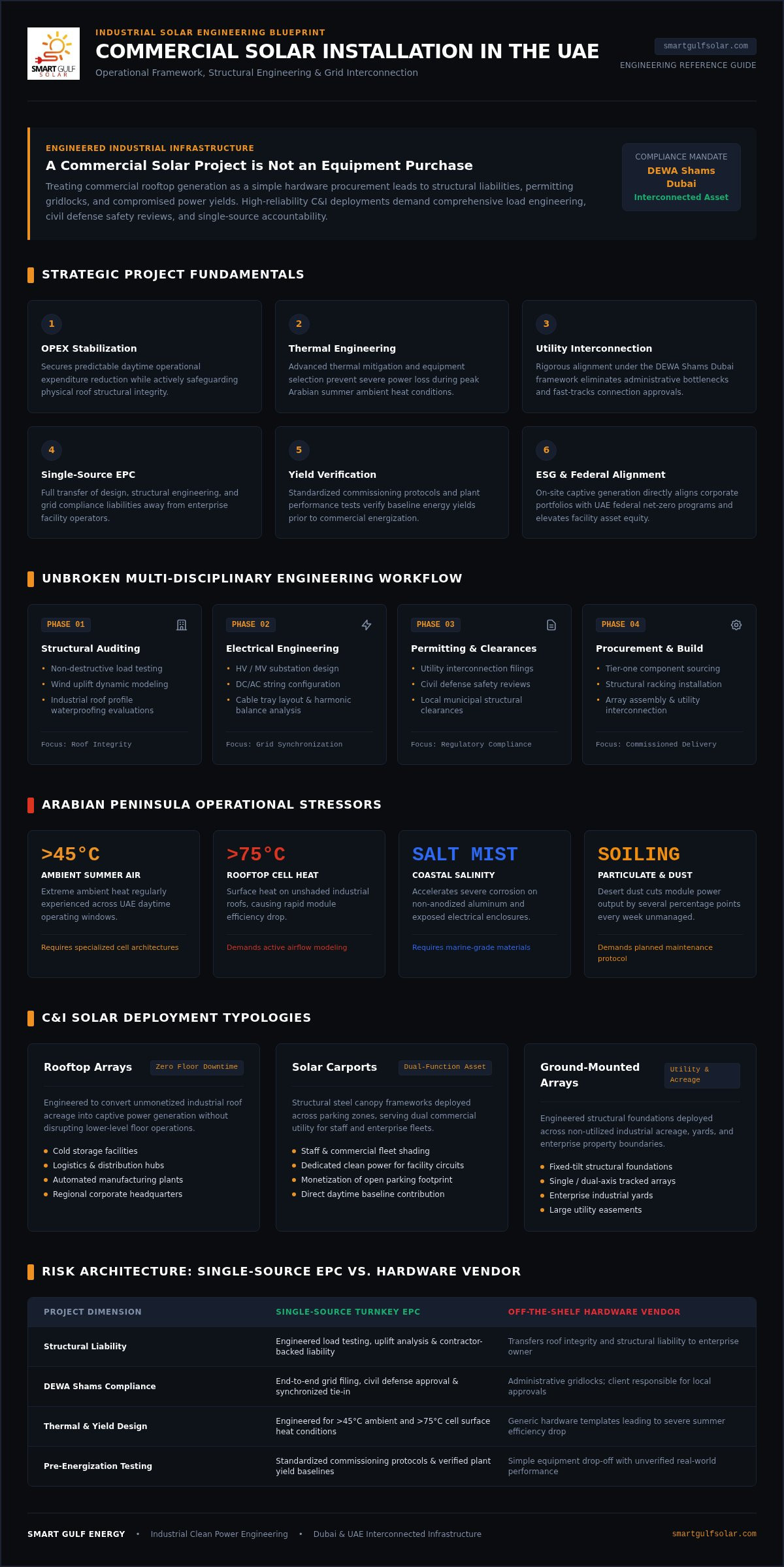
Executing a commercial solar installation UAE enterprise project demands heavy civil, structural, and electrical engineering. Commercial generation is not a software estimate or an over-the-counter equipment delivery. It is an industrial construction program. Rooftop surfaces, logistics zones, and open industrial acreage represent unmonetized enterprise assets. Converting them into power-generating infrastructure requires rigorous feasibility assessments, structural load calculations, and strict utility grid alignment.
Every commercial development must deliver absolute baseline power security. The broader development of Solar power in the United Arab Emirates reflects this transition toward utility-scale, high-reliability generation assets. Commercial facilities face escalating cooling loads and midday operational energy surges. Engineering a robust captive generation plant insulates operations against unpredictable operating expenditures, securing controllable daytime electricity margins across multi-decade lifecycle spans.
A true commercial deployment unifies multiple engineering disciplines into an unbroken workflow:
- Structural Auditing: Non-destructive physical load testing, wind uplift modeling, and waterproofing evaluations across industrial roof profiles.
- Electrical Engineering: High-voltage medium-voltage substation design, string configuration, cable tray layout, and harmonic balance analysis.
- Permitting and Authority Approvals: Interconnection filings, civil defense safety reviews, and local municipal structural clearances.
- Procurement and Construction: Tier-one component sourcing, structural racking installation, array assembly, and certified utility interconnection.
The Scope of Commercial and Industrial (C&I) Solar Deployments
Modern commercial infrastructure demands varied application footprints based on facility geometry and operational constraints:
- Rooftop arrays: Engineered for cold storage, logistics hubs, automated manufacturing plants, and regional corporate headquarters without disrupting lower-level floor activities.
- Solar carports: Structural steel canopy systems that provide employee and commercial fleet shading while generating dedicated clean power for facility circuits.
- Ground-mounted arrays: Fixed-tilt or tracked structural foundations installed across enterprise compounds, industrial yards, and large utility easements.
Strategic Financial and Operational Returns for UAE Enterprises
Deploying dedicated generation assets stabilizes operating margins across daytime operational baseloads, especially for energy-intensive cooling systems. Industrial facilities face substantial utility tariffs during peak operational windows. On-site solar generation delivers predictable, controllable energy costs that protect balance sheets against regional utility tariff adjustments.
Clean power infrastructure also anchors institutional ESG compliance. Installing utility-compliant commercial solar directly aligns corporate portfolios with federal net-zero programs, improving asset equity and satisfying enterprise sustainability benchmarks without sacrificing industrial productivity.
Engineering Criteria for High-Yield Gulf Solar Infrastructure
Operating a solar power plant in the Arabian Peninsula presents severe environmental stressors that standard international project templates simply ignore. Ambient summer temperatures regularly exceed 45°C. Cell temperatures on unshaded industrial roofs often surpass 75°C. Under these conditions, standard photovoltaic modules suffer significant efficiency loss. Designing a durable commercial solar installation UAE system requires specialized cell architectures, active airflow modeling, and resilient electrical topologies.
Atmospheric salinity and fine particulate matter present compounding operational risks along coastal and desert corridors. Dust deposition can cut module power output by several percentage points every week if left unmanaged. Salt mist accelerates corrosion across non-anodized aluminum frames, structural fasteners, and electrical enclosures. Aligning facility engineering with global renewable energy goals requires building generation plants capable of withstanding these local environmental stresses without rapid degradation.
Thermal Derating and High-Heat Cell Technologies
Module selection dictates long-term asset yield. Industrial builds prioritize N-type TOPCon or Heterojunction (HJT) modules because of their superior temperature coefficients, typically around -0.29% to -0.30% per degree Celsius. Racking systems must provide at least 150 millimeters of clearance above the roof surface. This vertical gap creates a continuous convective chimney effect, venting trapped thermal layers away from the array underside. Inverters must feature IP66 enclosures, active cooling systems, and internal heat pipes to prevent premature thermal throttling during peak afternoon generation.
Soiling Mitigation and Structural Integration
Maintaining high yields in arid environments requires engineered maintenance accessibility. Layout designs must include dedicated maintenance gangways and dry cleaning paths to support manual squeegees or autonomous robotic crawlers without stressing module glass. Hydrophobic anti-soiling coatings help shed surface sand, preserving optical transmission between wash intervals.
Roof integrity dictates array structural mechanics. Industrial facilities predominantly feature standing-seam or composite sandwich metal roofs. Mounting systems must use certified, non-penetrative clamp connections that preserve building envelope waterproofing while withstanding regional seasonal wind gusts. To evaluate your site's physical readiness, request an engineering audit through a dedicated Smart Quote assessment to model structural loads and thermal parameters before procurement.
Regulatory Compliance and the DEWA Shams Interconnection Framework
Connecting a distributed power plant to the utility grid involves rigorous regulatory oversight and technical governance. Under regional distribution codes, every commercial solar installation UAE project must integrate cleanly into local infrastructure without causing voltage volatility, harmonic distortion, or reverse power disruptions. In Dubai, grid interconnections follow the formal DEWA Shams Dubai framework, which dictates equipment certification, protection schemes, and maximum allowable capacity.
Utility regulations restrict these installations to existing rooftops, facades, and built structures. System sizing is strictly governed by the facility's connected electrical load, stepping from a 100 kVA allowance for loads up to 100 kW, up to a 1,000 kVA cap for loads between 501 kW and 5,000 kW, with an absolute program ceiling of 1 MW. Operating within these parameters requires precise engineering alignment from the earliest design iterations.
Sequential Utility Permitting and No Objection Certificates
Permitting begins with structured filings across municipal and utility authorities. Turnkey contractors assume full liability for securing the initial No Objection Certificate (NOC), Dubai Municipality structural clearances, and Civil Defense fire safety approvals. Engineering teams submit detailed electrical single-line diagrams, protection relay coordination studies, and ballast calculations. DEWA bundles NOC and connection applications into a unified submission, allowing engineers to confirm local distribution transformer capacities prior to on-site mobilization.
Inspection, Testing, and Bi-Directional Net Metering Setup
Physical array completion triggers rigorous verification protocols. Utility inspectors conduct on-site audits of interface protection relays, grounding grids, and inverter hardware, verifying compliance against DEWA Version 3.0 distributed generator standards. For installations exceeding 100 kW, technicians must complete a formal plant performance test to prove active grid compliance and rapid anti-islanding response. Following technical sign-off, the utility installs certified bidirectional metering, clearing the plant for live synchronization and immediate net-metering generation.
Turnkey EPC Contractor vs Hardware Vendor: Mitigating Project Risk
Procuring solar hardware directly shifts engineering, structural, and regulatory liabilities entirely onto the asset owner. Solar panels and inverters aren't plug-and-play appliances. Executing a successful commercial solar installation UAE program demands strict alignment between civil structural engineering, medium-voltage distribution, and municipal governance.
Fragmenting these disciplines across separate vendors creates immediate operational exposure. A single miscalculation in wind uplift engineering or cable sizing can halt warehouse operations, fail municipal inspections, and void equipment warranties. Turnkey delivery establishes single-source accountability from day one.
The Shortcomings of Component-Only Procurement
Hardware vendors supply standalone equipment, but they don't take responsibility for field performance. When an array underperforms, component distributors routinely blame improper electrical integration or flawed balance-of-system engineering. This blame shifting leaves enterprise managers trapped between finger-pointing suppliers and third-party electrical installers.
Managing disparate subcontractors introduces severe logistical risks across active commercial facilities. Rigging cranes, civil staging, and electrical trenching require precise site choreography. Uncoordinated equipment arrivals lead to congested loading bays, expensive laydown storage penalties, and unbudgeted operational downtime for active distribution centers.
The Strategic Advantage of Single-Source EPC Delivery
Full-scope turnkey EPC contracts eliminate operational friction by consolidating liability under a single prime contractor. The master builder assumes complete responsibility for feasibility modeling, structural integration, global tier-one procurement, civil construction, and utility energization. Bankable performance ratios protect your investment from design through commissioning.
Established regional contractors leverage long-standing industrial supply chains and decades of local engineering heritage. This organizational maturity ensures seamless site coordination without disrupting round-the-clock manufacturing schedules or logistics operations. Partner with our solar PV EPC team to execute your commercial build with end-to-end technical accountability and zero operational compromise.
Commissioning, Asset Management, and Execution Timelines
Completing physical assembly is only the halfway mark of asset realization. True commercial performance depends on strict commissioning standards and structured operational maintenance. For any commercial solar installation UAE facility, energization marks the start of a 25-year operational lifecycle where unmonitored string outages or dust settlement can rapidly diminish expected economic returns.
Execution schedules must account for systematic electrical handoffs. Transitioning from cold mechanical completion to a fully synchronized, generating power plant demands rigorous testing protocols that safeguard industrial switchgear and verify every engineering calculation made during initial design.
Rigorous Testing Protocols and System Commissioning
Commissioning moves forward through distinct electrical phases before utility energization:
- Cold commissioning: Insulation resistance testing, string open-circuit voltage verification, polarity confirmation, and torque checks across structural clamps and electrical terminations.
- Hot commissioning: Controlled breaker closures, dynamic inverter synchronization, maximum power point tracking (MPPT) validation, and harmonic distortion verification under full grid load.
- Closeout documentation: Delivery of the verified as-built drawing package, operation and maintenance schematics, calibrated test sheets, and equipment factory warranties.
Asset Management, Preventative Maintenance, and Project Initiation
Arid desert environments demand active, physical asset stewardship. Industrial facilities integrate SCADA architectures with high-precision environmental sensors to benchmark real-time kilowatt-hour production against expected solar irradiance. Automated alerts instantly isolate single-string dropouts, ground faults, or localized module hotspots.
Scheduled maintenance protocols combine regular autonomous panel washing with aerial thermographic drone audits. High-resolution infrared mapping spots micro-cracks, diode failures, and cell discoloration long before they trigger inverter-level shutdowns.
Securing these long-term returns starts with disciplined initial engineering. Institutional asset owners can review facility parameters and establish an actionable project baseline through Smart Gulf Energy, deploying single-source EPC execution built for Gulf operating realities.
Deploying Industrial Solar Infrastructure with Execution Certainty
Treating your energy transition as an industrial engineering program protects operating margins against volatile peak utility rates. Long-term asset yield across the Gulf demands high-heat module engineering, non-penetrative structural mounting, and synchronized utility compliance. Single-source delivery eliminates the operational liabilities of fragmented subcontracting, ensuring your roof remains watertight and your facility stays fully operational.
Operating across Dubai and the wider region since 2005, Smart Gulf Energy delivers comprehensive turnkey execution under the industrial heritage of Arabian Group of Companies, established in 1988. We manage every phase of your commercial solar installation UAE project, from initial structural load auditing and DEWA permitting through to grid connection and SCADA-monitored asset stewardship.
Transform underutilized industrial space into a reliable, captive power generation asset. Initiate your commercial project assessment with Smart Gulf Energy to engineer a high-yield solar deployment built for local operating realities.
Frequently Asked Questions
How long does a commercial solar installation take to complete in the UAE?
A standard commercial solar installation UAE project typically spans three to six months from initial design to final grid energization. Permitting and utility approvals through DEWA or regional authorities usually take four to eight weeks. Procurement, structural mounting, and electrical wiring require six to ten weeks depending on facility scale. Final utility inspection, witness testing, and meter installation take another two to four weeks.
What are the structural requirements for installing commercial solar on industrial warehouse roofs?
Roof structures must support dead loads of 12 to 18 kilograms per square meter along with localized wind uplift pressures. Engineers conduct non-destructive pull-out tests and ultrasonic thickness audits on purlins and decking. For standing-seam and sandwich panels, certified non-penetrating clamps attach directly to structural seams. This secures the array against seasonal storms while preserving existing building envelope waterproofing warranties without drilling holes into the roof deck.
How does the DEWA Shams Dubai net metering program work for commercial facilities?
The DEWA Shams Dubai initiative permits commercial accounts to offset electricity bills by feeding excess solar energy back to the distribution grid. Generated units offset building consumption in real time. Surplus kilowatt-hours flow through a bidirectional meter and earn billing credits against future utility invoices. System capacities are capped according to connected load, with a program maximum limit of 1 MW per facility account.
How do extreme heat and desert dust affect solar panel efficiency in Dubai?
Extreme ambient temperatures raise cell temperatures past standard test conditions, decreasing voltage output through thermal derating. Dust accumulation and particulate matter create surface soiling that blocks direct irradiance, cutting generation by several percentage points every week if left unmanaged. Mitigating these losses requires deploying low temperature coefficient N-type TOPCon modules, maintaining elevated roof ventilation clearances, and implementing scheduled autonomous dry-cleaning protocols.
What is the difference between a solar equipment supplier and a turnkey EPC contractor?
An equipment supplier merely sells hardware, leaving structural modeling, permitting, construction safety, and grid compliance risks entirely with the facility operator. A turnkey commercial solar installation UAE EPC contractor handles end-to-end delivery under single-point liability. This scope encompasses feasibility auditing, civil engineering, authority No Objection Certificates, procurement, installation, and formal utility synchronization, guaranteeing bankable performance ratios from inception through operations.
Can a commercial solar system be integrated with battery energy storage (BESS) in the UAE?
Yes, commercial arrays can integrate utility-grade Battery Energy Storage Systems (BESS) to capture excess midday production and shave peak-hour grid demand. Storage systems are essential under self-consumption frameworks where grid export credits aren't provided, such as Abu Dhabi's self-supply policy. Turnkey EPC contractors engineer DC-coupled or AC-coupled battery architectures with dedicated power conversion systems and active thermal management to ensure fire-safe, reliable dispatch.
Will daily commercial or industrial facility operations be disrupted during installation?
Facility operations continue uninterrupted throughout a properly managed turnkey EPC build. Racking and module assembly occur exclusively on the roof envelope, while crane lifts and heavy laydown deliveries are scheduled outside peak logistical hours. Electrical cutovers to tie the solar plant into the main distribution board or substation switchgear are executed during planned maintenance windows or scheduled facility shutdowns to avoid operational downtime.


