

Rooftop racking and bolted panels do not create an energized, revenue-generating commercial asset. The fundamental distinction between a solar EPC contractor vs installer isn't about physical trades; it centers on who shoulders legal and financial risk when system engineering fails or utility interconnection stalls.
Deploying commercial power infrastructure is demanding. When liability splinters across separate design engineers, hardware suppliers, and field crews, minor technical misalignments quickly trigger utility rejections, costly grid delays, and long-term generation losses. Protecting enterprise capital requires single-source operational control rather than fractured accountability.
In this guide, you'll examine the operational boundaries between turnkey EPC delivery and basic mechanical installation so you can safeguard your commercial asset and ensure project bankability. We break down the division of liabilities, regulatory compliance pathways, and an objective contractor selection framework tailored to facility scale.
Key Takeaways
- Understand the operational divide in a solar EPC contractor vs installer engagement, separating trade-level mechanical mounting from comprehensive balance-of-system engineering.
- Eliminate multi-party friction by establishing single-source accountability for project design, equipment procurement, and field construction risks.
- Streamline grid interconnection and regional utility approvals by leveraging dedicated medium-voltage engineering and compliance governance.
- Apply an objective evaluation framework to match contractor capabilities with your facility's physical scale, structural profile, and electrical demands.
- Protect capital investment and ensure bankable asset performance through coordinated procurement standards and certified structural modeling.
Solar EPC Contractor vs Installer: Defining Core Roles and Project Scope
Many commercial procurement teams treat these two entities as interchangeable service providers. That is a costly operational mistake. The core distinction in evaluating a solar EPC contractor vs installer centers on legal accountability, system performance guarantees, and design liability. An installer specializes in tactical trade labor. An EPC contractor assumes single-source commercial responsibility for converting capital into an operational, grid-connected power plant.
The Functional Scope of a Specialized Solar Installer
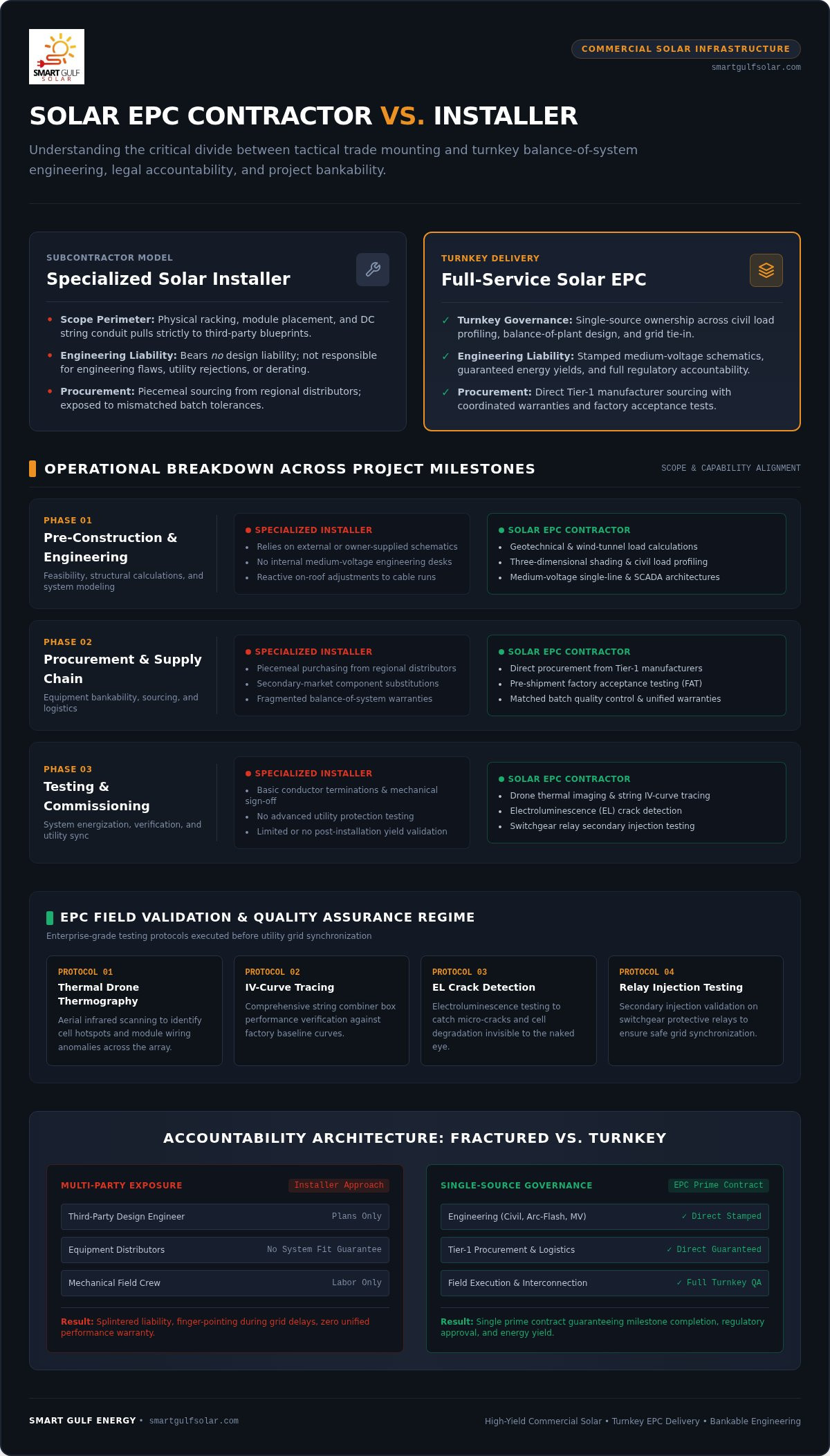
A specialized solar installer operates primarily as a mechanical and electrical subcontractor. Their operational perimeter focuses on physical racking, module placement, and running DC string conduits according to schematics provided by third parties. Installers don't conduct structural yield modeling, stamp medium-voltage distribution schematics, or negotiate utility interconnection agreements. If the engineering plans contain flaws that trigger permitting rejections or field derating, the installer bears no legal or financial liability. Their job is simply to mount hardware and pull cable according to specs.
The End-to-End Governance of an EPC Contractor
In contrast, an entity delivering under an Engineering, Procurement, and Construction (EPC) model takes turnkey ownership of the entire asset lifecycle. The EPC contractor manages civil load profiling, electrical arc-flash calculations, and balance-of-plant design before moving into procurement. They direct Tier-1 equipment supply chains, conduct factory acceptance tests, coordinate specialized field trades, and govern utility grid synchronizations. Every phase connects under one prime contract that guarantees energy yield and milestone delivery.
Commercial power infrastructure demands rigorous technical execution. Segmenting these roles clarifies accountability across critical project milestones:
- Design Liability: Installers build strictly to external blueprints; EPC contractors stamp, validate, and assume legal responsibility for the underlying engineering.
- Procurement Risk: Installers assemble assigned hardware; EPC contractors manage Tier-1 equipment vetting, logistical delivery schedules, and component defect exposure.
- Utility Commissioning: Installers terminate conductors; EPC contractors navigate regulatory compliance, protection settings, and authority approvals to achieve commercial operation.
Comparative Scope Analysis: Engineering, Procurement, and Construction Execution
Execution capabilities diverge rapidly once project specifications move from concept to physical reality. Analyzing a solar EPC contractor vs installer across day-to-day operations reveals stark differences in engineering depth, supply chain leverage, and field commissioning standards.
Pre-Construction Engineering and Site Feasibility
Engineering determines project longevity long before civil work starts. An EPC conducts thorough geotechnical assessments, wind-tunnel load calculations, and three-dimensional shading simulations. Their electrical engineers draft precise medium-voltage single-line diagrams, short-circuit current calculations, and SCADA monitoring architectures. Installers rarely possess internal engineering desks. They rely on owner-supplied drawings or permit-expediting shops, often adjusting cable runs or component placements reactively on the roof.
Procurement Strategy and Equipment Bankability
Direct supply chain leverage protects capital. An EPC bypasses local intermediaries, procuring utility-grade modules and centralized inverters directly from Tier-1 manufacturers. This direct engagement guarantees matched equipment warranties, strict batch quality control, and factory pre-shipment inspections. Installers typically buy piecemeal from regional distributors. That model leaves projects exposed to mismatched batch tolerances, secondary-market component substitutions, and uncoordinated balance-of-system warranties.
Commissioning, Quality Assurance, and Testing Protocols
Power generation requires rigorous field validation. EPC contractors govern formal quality assurance regimes using thermal drone thermography, IV-curve tracing across all string combiner boxes, and electroluminescence crack detection. Switchgear protective relays undergo secondary injection testing before utility synchronization. Installers normally limit testing to basic open-circuit voltage checks and polarity verifications before requesting final municipal building sign-off.
For asset managers reviewing how to choose a qualified solar installer or prime contractor, technical execution dictates commercial asset life:
- Balance of System Optimization: EPCs run cable ampacity and voltage drop modeling to limit lifetime energy losses under 1.5%; installers run standard wire gauge selections that can lead to thermal throttling.
- Structural Integrity: EPCs calculate dynamic wind uplift and building dead loads; installers rely on generic manufacturer racking rail tables.
- High-Voltage Integration: EPCs coordinate step-up transformers, switchgear protection settings, and utility telemetry; installers terminate at the main low-voltage distribution board.
When planning multi-megawatt commercial rooftop or ground-mount assets, facilities teams leverage turnkey solar PV EPC installation to lock down engineering accuracy and protect capital allocations from day one.
Risk Allocation, Permitting, and Grid Interconnection Governance
Project failure in commercial solar rarely stems from a broken module. It happens in the regulatory gaps between separate contracts. Evaluating a solar EPC contractor vs installer requires looking past hardware assembly and confronting who bears financial liability when an asset fails to secure permission to operate.
Single-Source Accountability vs Split-Scope Risk
Splitting scopes creates immediate friction. When an owner hires an engineering firm, buys equipment directly, and contracts an installer for labor, liabilities scatter. If string voltages trigger inverter clipping or hot spots emerge, the installer blames poor design schematics. The engineer blames field installation tolerances. The supplier blames improper handling. The asset owner pays for the resulting downtime.
Turnkey EPC delivery eliminates this triangle. A prime EPC contract consolidates balance-of-system engineering, equipment procurement, and field construction under one balance sheet. Commercial contracts enforce performance ratios, milestone schedules, and liquidated damages against the EPC partner alone. Because an EPC contract provides a single legal entity to hold accountable, commercial lenders view turnkey structures as an absolute prerequisite for non-recourse project financing.
Utility Permitting and Compliance Standards
Regional grid operators enforce stringent technical gatekeeping before energizing high-capacity systems. In Dubai, for instance, connecting a commercial PV array requires rigorous compliance with DEWA Shams Dubai standards, including anti-islanding protection, power factor controls, and certified interface protection units. Navigating these requirements demands an accredited, DEWA-approved contractor equipped to manage regulatory filings alongside civil defense safety sign-offs and municipal building permits.
Grid integration delays can leave complete, physically installed arrays stranded behind padlocked breaker cabinets for months. The primary drivers of permitting bottlenecks include:
- Substation Impact Studies: Installers lack medium-voltage engineers to calculate reverse power flow risks, fault levels, or transformer saturation points.
- Protection Relay Coordination: Utility networks reject single-line submittals that fail to model precise trip curves, transfer-trip communications, and voltage disturbance ride-through profiles.
- Authority Approvals: Approved EPC contractors maintain direct engineering dialogues with utility review boards, securing statutory compliance on initial submittals rather than cycling through iterative design rejections.
Hardware on the roof yields zero revenue until the utility meter spins. Choosing an execution partner with demonstrated regulatory clearance capabilities ensures physical construction translates directly into an active, compliant, revenue-generating power plant.
Decision Matrix: How to Choose Between an EPC Contractor and an Installer
Selecting the right execution partner depends on facility scale, electrical architecture, and internal management capacity. Small distributed systems rarely need the governance of a prime contractor. Conversely, complex commercial facilities break down when managed through fragmented subcontractor trades. Deciding between a solar EPC contractor vs installer requires evaluating where technical liabilities truly sit.
Determining Project Scale and Complexity Triggers
System capacity dictates the operational threshold. Standard arrays below 20 kW don't require specialized medium-voltage engineering or dynamic grid simulation. A qualified installer handles those routine low-voltage tie-ins effectively without excess overhead.
Industrial scale changes the equation completely. Facilities exceeding 250 kW introduce structural dead loads, wind uplift stresses, and medium-voltage grid sync demands. Adding Battery Storage Systems for peak shaving or backup resilience introduces another layer of control architecture that installers cannot engineer. Managing separate engineering, procurement, and labor vendors in-house demands dedicated technical staff. Without that internal bandwidth, asset owners face compounding project risk and severe budget creep.
Five-Step Verification Framework for Commercial Tenders
Commercial tender evaluations must rely on verified technical competence rather than marketing claims. Institutional procurement teams should enforce this five-step audit before awarding any contract:
- Utility Accreditations: Verify active licensing with regional grid authorities, such as holding accredited DEWA-approved contractor status, to prevent interconnection stalls.
- Safety Governance: Inspect audited safety records and Lost Time Injury Frequency Rates (LTIFR) to ensure field execution meets industrial facility standards.
- Financial Solvency: Review balance-sheet stability and bankability ratings to guarantee the contractor can back up performance bonds and yield liquidated damages.
- In-House Engineering: Confirm dedicated structural, civil, and electrical engineers sit in-house rather than being outsourced to unvetted drafting shops.
- Megawatt Track Record: Inspect documented performance data from previously energized commercial assets operating under similar environmental conditions.
Enterprise power generation demands single-source execution built on certified industrial standards. If your organization is preparing a commercial or industrial rooftop deployment, request a Smart Quote to initiate a technical feasibility review with our engineering desk.
Deploying High-Yield Commercial Solar with Smart Gulf Energy
Protecting commercial capital requires an execution partner with demonstrated operational longevity and balance-sheet strength. Smart Gulf Energy delivers comprehensive turnkey solar PV EPC installation and integrated Battery Storage Systems across commercial, industrial, and utility-scale developments. Operating since 2005 as a subsidiary of the Arabian Group of Companies, established in 1988, our organization pairs industrial heritage with modern engineering discipline.
Turnkey Commercial and Industrial Asset Delivery
Harsh operating environments quickly expose weak design. Smart Gulf Energy engineers solar infrastructure specifically calculated to endure extreme ambient heat, heavy dust loads, and severe thermal expansion. Our technical team tailors every balance-of-plant component to sustain generation yield under demanding regional conditions.
Beyond traditional generation, we integrate commercial Battery Storage Systems to mitigate peak demand penalties and optimize energy arbitrage. Our engineering desk models charge-discharge profiles directly against facility consumption curves, ensuring maximum self-consumption. Every stage proceeds under direct in-house governance, spanning structural modeling, Tier-1 hardware vetting, civil execution, and switchgear energization.
Institutional Reliability and Execution Governance
Subcontracting vital technical workflows to disparate third parties introduces compounding failure points. Smart Gulf Energy eliminates vendor finger-pointing by maintaining single-source control over engineering, procurement, and field commissioning. As an accredited DEWA-approved contractor, our team manages regulatory filings directly, securing permits, civil defense approvals, and grid connection clearance on schedule.
The operational divide in a solar EPC contractor vs installer engagement defines whether your facility gains a simple rooftop fixture or an optimized, bankable power plant. Our turnkey framework provides the structural governance and certified execution required to de-risk heavy capital investments:
- Unified Procurement: Direct manufacturer relationships guarantee tier-rated component quality, verified bill of materials, and matched equipment warranties.
- Regulatory Velocity: Certified engineering submittals streamline authority approvals and expedite official permission to operate.
- Guaranteed Performance: Single-point accountability locks in project timelines, installation standards, and asset performance ratios.
Initiate your commercial project with Smart Gulf Energy to connect directly with our project delivery team and build bankable clean power infrastructure.
Securing Long-Term Yield Through Single-Source Project Delivery
Commercial power infrastructure succeeds or fails at the contract level. While field labor mounts panels, only comprehensive engineering protects capital from interconnection delays, utility non-compliance, and unhedged generation shortfalls. Understanding the operational divide in a solar EPC contractor vs installer engagement ensures you don't treat multi-megawatt industrial assets like routine electrical work.
Smart Gulf Energy eliminates multi-party friction by taking full ownership of your clean energy deployment. Delivering commercial and utility-scale solar PV and storage assets since 2005 under the Arabian Group of Companies, established in 1988, our team brings industrial sobriety to every project milestone. As an accredited DEWA-approved contractor, we manage end-to-end engineering, statutory approvals, and grid energization with absolute procedural rigor.
Deploy your commercial solar asset with Smart Gulf Energy to secure bankable balance-of-plant design and protect your capital investment from initial modeling through final grid synchronization.
Frequently Asked Questions
What is the main difference between a solar EPC contractor and a solar installer?
The fundamental distinction in a solar EPC contractor vs installer comparison comes down to project accountability and engineering depth. An installer focuses on field labor, mechanically mounting modules and pulling electrical cabling to third-party specs. A turnkey EPC contractor delivers end-to-end design, direct manufacturer procurement, structural load profiling, statutory utility permitting, and commissioning, guaranteeing the power plant's generation performance under a single commercial contract.
Can a standard electrical installer complete commercial solar grid connections?
No, commercial grid interconnections demand specialized medium-voltage engineering, protection relay settings, and utility accreditations that standard electrical installers lack. High-capacity commercial arrays require dynamic fault calculations, SCADA communication integration, and interface protection coordination. Standard trade installers don't carry the balance-of-plant design liability or regulatory credentials needed to satisfy transmission operators and secure official authorization to synchronize with the distribution network.
Why do commercial lenders and banks require a turnkey solar EPC contract?
Institutional lenders mandate turnkey EPC contracts to eliminate multi-party liability risks during project financing. Under split-scope arrangements, equipment suppliers, structural engineers, and field installers often blame one another for schedule delays or yield shortfalls. A turnkey EPC contractor acts as a single balance sheet responsible for delivery milestones, performance ratio benchmarks, and output guarantees, providing the financial certainty banks require to underwrite commercial debt.
How does an EPC contractor handle utility approvals and grid permitting?
An accredited EPC contractor manages the entire statutory compliance lifecycle directly with regional transmission and distribution authorities. In Dubai, this includes handling DEWA Shams Dubai approvals, preparing civil defense filings, conducting power quality studies, and coordinating physical witness testing. In-house engineers draft single-line diagrams to exact utility standards, preventing iterative rejection cycles and ensuring switchgear energization proceeds without regulatory delays.
When is it appropriate to hire a standard solar installer instead of an EPC firm?
Standard installers suit low-complexity residential systems below 20 kW where structural dead loads, electrical protections, and permitting paths follow standard municipal templates. Hiring an installer also works if your enterprise maintains an in-house engineering desk capable of procurement, structural modeling, and balance-of-plant coordination. When evaluating a solar EPC contractor vs installer for complex facilities, skipping an EPC introduces severe operational friction.
What warranties and performance guarantees come with a turnkey EPC project?
Turnkey EPC contracts integrate comprehensive protections across workmanship, equipment, and actual plant yield. Beyond passing through manufacturer product warranties for modules and inverters, the EPC contractor provides an overall system workmanship warranty. Crucially, the prime contract establishes legally enforceable performance ratio guarantees and plant availability benchmarks, holding the builder directly accountable for energy generation during the commercial asset lifecycle.


