
Fragmented procurement models destroy commercial energy returns before the first panel is ever energized. When separate civil crews, equipment vendors, and electrical installers divide project responsibilities, industrial asset owners inherit the operational fallout. Engaging an established solar EPC contractor Dubai enterprises can rely on eliminates that split liability, replacing subcontractor friction with decisive, single-source execution.
You already know that commercial solar infrastructure must do far more than satisfy corporate sustainability benchmarks. It has to withstand extreme ambient heat, resist fine dust soiling, and generate bankable yields that defend your balance sheet. This engineering guide shows you how to evaluate, vet, and contract a partner capable of assuming end-to-end liability with guaranteed DEWA grid connectivity.
We break down mandatory DRRG technical standards, Hab Reeh approval workflows, and the rigorous design practices that secure predictable power output across a 25-year operating lifecycle.
Key Takeaways
- Eliminate multi-vendor risk by partnering with a qualified solar EPC contractor Dubai organizations trust for end-to-end engineering, procurement, and grid energization.
- Audit prospective contractors against DEWA DRRG technical regulations and Hab Reeh digital submission workflows to prevent connection bottlenecks.
- Deploy climate-resilient component specifications designed to counter extreme ambient heat, thermal derating, and abrasive desert soiling.
- Structure commercial Shams Dubai projects around rigorous milestone gates to secure bankable energy yields across a 25-year asset lifecycle.
What Is a Turnkey Solar EPC Contractor?
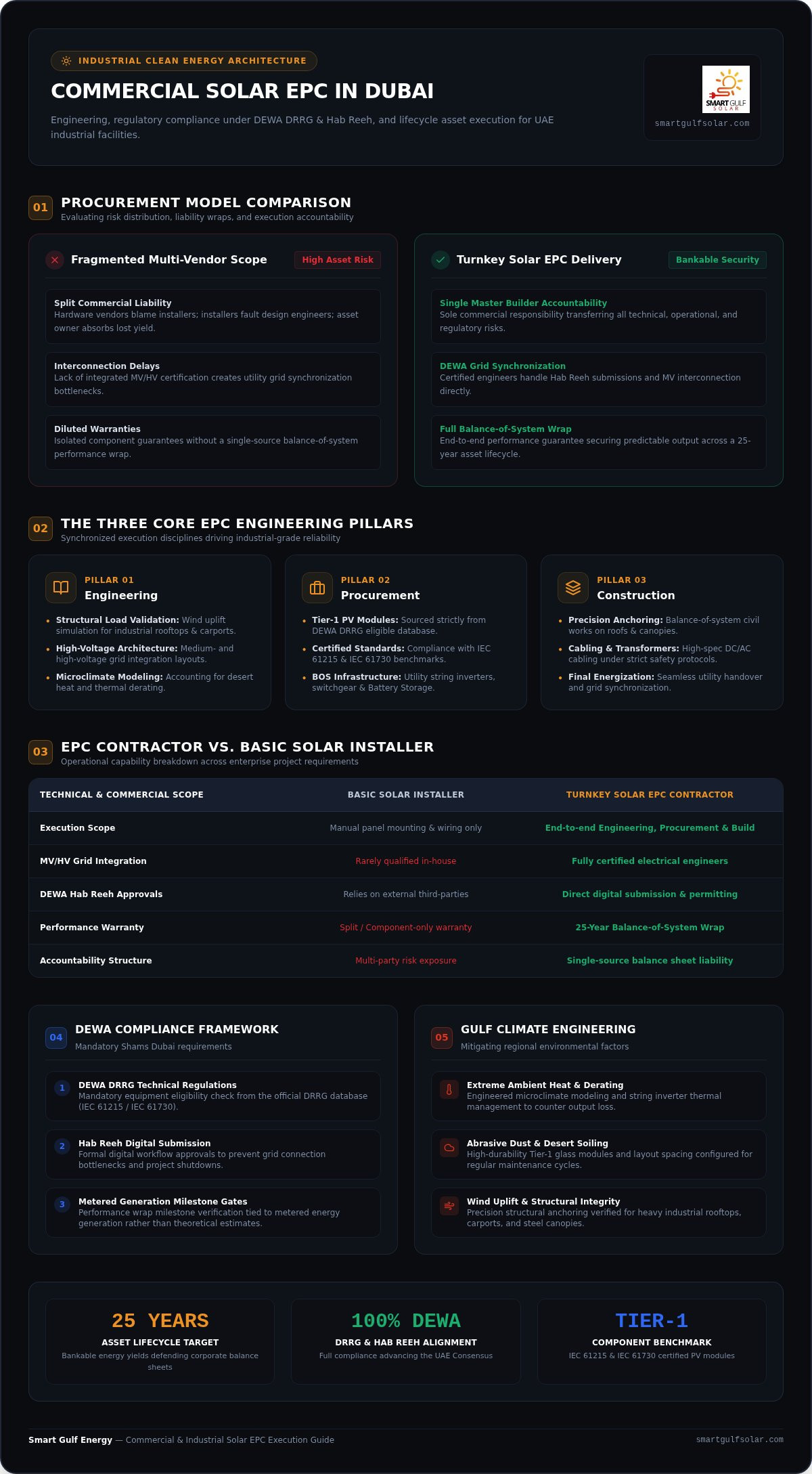
Enterprise infrastructure demands absolute operational accountability. Many industrial facility operators mistakenly treat clean energy deployment as a routine electrical retrofit, engaging fragmented component brokers, civil builders, and third-party wiring subcontractors. This split-scope model dilutes liability. When production targets drop or grid synchronization stalls, hardware vendors blame installation crews, installers fault design engineers, and the asset owner absorbs the financial fallout.
A turnkey Engineering, procurement, and construction (EPC) framework replaces this operational friction with a unified balance-of-system warranty and complete performance wrap. Contracting an established solar EPC contractor Dubai facility managers trust transfers every technical, operational, and regulatory risk to a single master builder from baseline feasibility through final energization.
The Core Pillars: Engineering, Procurement, and Construction
True turnkey delivery operates across three synchronized engineering disciplines:
- Engineering: Structural load validation, high-voltage electrical architecture, and microclimate irradiance modeling that directly account for regional thermal derating and wind uplift.
- Procurement: Direct acquisition of Tier-1 solar modules, utility-grade string inverters, and medium-voltage switchgear engineered to withstand severe ambient environments.
- Construction: Precision structural anchoring, balance-of-system civil works, DC/AC cabling, and transformer installation executed under rigorous site safety protocols.
A turnkey EPC contractor assumes sole commercial liability for delivering a fully commissioned, grid-connected power asset within specified timelines and financial targets.
EPC Contractor vs. Solar Installer: Operational Distinction
Basic solar installers operate strictly within the manual scope of panel mounting and terminal wiring. They rarely possess the internal engineering depth to execute medium-voltage grid integration, structural wind-load simulations, or complex municipal permitting.
In contrast, a specialized commercial solar EPC contractor Dubai industrial operators select manages the entire regulatory and engineering ecosystem. The EPC firm guarantees power generation thresholds, manages grid interconnection liabilities, and protects the capital asset against compounding schedule delays.
Vetting Solar EPC Contractors in Dubai: Technical Criteria
Selecting a clean energy delivery partner requires strict technical due diligence. Enterprise stakeholders cannot afford to treat multi-megawatt solar procurement like routine facilities maintenance. Awarding contracts based solely on lowest-capital bidding often invites severe operational compromises: undersized conductors, thermal failure, and stalled utility handovers. A qualified partner must demonstrate proven balance-sheet solvency, deep electrical engineering capabilities, and unbroken compliance records.
Regulatory Accreditation and Utility Licensing
Formal contractor enrollment with the Dubai Electricity and Water Authority (DEWA) is the baseline requirement. Unaccredited entities cannot interface with municipal submission systems or sign off on grid connections. Vetting requires confirming that the firm employs certified electrical engineers qualified for medium- and high-voltage grid interconnection works. Partnering with certified specialists ensures your commercial facility actively advances the UAE Consensus on renewable energy while avoiding municipal permitting shutdowns.
Procurement Integrity and Tier-1 Equipment Selection
Asset longevity depends entirely on balance-of-system procurement rigor. An established solar EPC contractor Dubai commercial operators rely on secures Tier-1 photovoltaic modules certified to IEC 61215 and IEC 61730 standards, sourced directly through DEWA's DRRG eligible equipment database. Beyond solar modules, utility-grade inverter architectures must feature integrated remote diagnostics, rapid-shutdown controls, and robust surge suppression. Contractors must also demonstrate proven engineering capability in co-locating commercial Battery Storage Systems to support plant flexibility and microgrid integration.
Execution Track Record and Single-Source Accountability
Corporate longevity and balance-sheet liquidity dictate whether an engineering contractor can underwrite long-term performance obligations. Audit prospective partners for completed multi-megawatt commercial rooftops, industrial carports, and complex steel canopy installations. Demand comprehensive performance wraps that tie contractor milestones directly to metered energy generation rather than theoretical yield estimates. Before allocating capital, industrial facility managers can request a preliminary Smart Quote for commercial solar deployment to establish clear engineering parameters and verify contractor execution capacity.
The Solar EPC Project Lifecycle Under DEWA Shams
Grid integration in Dubai follows a strictly regulated engineering sequence governed by DEWA's Distributed Renewable Resources Generator standards. Cutting corners during preliminary calculations or skipping formal compliance stages invariably leads to costly redesigns and utility rejection. A qualified solar EPC contractor Dubai industrial developers select manages this multi-phase process through unified milestone governance, keeping civil, electrical, and administrative tasks fully synchronized.
Engineering Feasibility and Structural Assessment
Deployment begins with forensic structural analysis. Engineers calculate dead, live, and wind-uplift loads across rooftop purlins and standing-seam profiles to confirm structural safety before equipment staging. High-resolution three-dimensional computational modeling identifies shading from parapets, HVAC plant rooms, and adjacent facilities. Designers optimize the DC-to-AC capacity ratio against client load curves and the 1 MW single-plot capacity cap, locking in peak generation profiles without risking export clipping.
DEWA Permitting and Interconnection Approvals
Every commercial grid connection must pass through DEWA's Hab Reeh digital platform. The contractor compiles single-line diagrams, protection scheme settings, plant layouts, and equipment compliance certificates for formal utility review. Simultaneous coordination secures municipal building permits and Civil Defense safety clearances. Physical construction commences only after DEWA issues the formal No Objection Certificate (NOC), protecting building owners from regulatory penalties or mandatory site alterations.
Construction, Commissioning, and Grid Energization
Site execution demands disciplined balance-of-system assembly and electrical terminations. Certified field crews install aerodynamic mounting systems, run UV-rated solar cabling through dedicated cable trays, and land terminations inside weather-rated switchgear:
- Pre-Commissioning Testing: Technicians execute cold and hot commissioning under IEC 62446 standards, documenting open-circuit voltages, string polarities, insulation resistance, and thermographic scans.
- Utility Inspection: DEWA engineers conduct site verification audits, testing interface protection relays and system anti-islanding mechanisms.
- Meter Integration: The utility installs bidirectional check and generation meters, formalizing grid synchronization.
Once DEWA issues final inspection sign-off, the facility transitions from cold commissioning to active commercial power export in a matter of hours. Having a certified solar EPC contractor Dubai enterprises trust ensures this four-phase lifecycle moves smoothly from initial structural audit to live energization without bureaucratic delays.
Engineering for the Gulf Climate: Heat, Sand, and Degradation
Operating solar assets in the Arabian Gulf exposes components to some of the world's harshest environmental stresses. Ambient summer temperatures regularly exceed 45 degrees Celsius, pushing rooftop module surface temperatures past 75 degrees Celsius. Under these conditions, generic commercial equipment experiences rapid thermal derating, severe cell browning, and premature sealant failure. Sustaining high yield ratios across decades requires targeted engineering solutions purpose-built for extreme heat and desert exposure.
Thermal Derating Mitigation and Cell Architecture
Every degree Celsius above standard test conditions saps module output. Specifying photovoltaic modules with exceptionally low negative temperature coefficients is essential to stem hot-weather generation losses. Modern installations leverage N-Type TOPCon or heterojunction (HJT) cell architectures, which retain higher conversion efficiencies under elevated operating heat compared to legacy P-type PERC technology. Structural mounting layouts must also incorporate calculated tilt angles and deliberate clearance gaps beneath arrays, maintaining natural convection airflow to cool module undersides passively.
Combating Soiling and Particulate Build-Up
Fine particulate dust layers and periodic regional sandstorms present an immediate drag on commercial balance sheets. Airborne silt forms an opaque crust across solar glass, blocking irradiance and causing up to 30% yield loss if left unmanaged across dry months. An experienced solar EPC contractor Dubai industrial developers engage designs arrays specifically around proactive cleaning operations. Solutions include factory-applied hydrophobic anti-soiling glass coatings, alongside waterless, automated robotic cleaning tracks that sweep modules nightly without consuming costly desalinated water.
Balance-of-System Resilience in Coastal Climates
Dubai's coastal corridors bring intense humidity and airborne salinity, accelerating galvanic corrosion across sub-par balance-of-system hardware. Structural integrity demands high-grade anodized aluminum racking combined with marine-grade 316 stainless steel fasteners:
- Enclosure Protection: Central and string inverters must feature certified IP66-rated weather enclosures to block fine sand penetration and corrosive moisture ingress.
- Cable Longevity: Exposed electrical circuits require cross-linked, halogen-free, UV-resistant cabling capable of enduring decades of uninterrupted ultraviolet exposure without sheath cracking.
- Potential-Induced Degradation (PID): Module and inverter architectures must incorporate active negative grounding or specialized anti-PID cell technology to prevent systemic voltage leakages.
Protecting commercial solar investments against environmental degradation demands uncompromising balance-of-plant design. Connect with Smart Gulf Energy at smartgulfsolar.com to evaluate climate-resilient engineering specifications tailored to your industrial facility.
Commercial Delivery: Building Industrial Assets with Smart Gulf Energy
Executing heavy clean energy infrastructure demands absolute operational competence. Institutional asset owners cannot entrust commercial power plants to unproven market entrants or loose subcontractor consortiums. Smart Gulf Energy serves as Dubai's dedicated prime contractor, engineering resilient industrial solar installations that protect balance sheets and secure operational self-reliance. As an established solar EPC contractor Dubai enterprises rely on, the firm eliminates delivery ambiguity by retaining single-source accountability across the entire asset lifecycle.
Four Decades of Industrial Heritage and Technical Maturity
Founded in 2005 under the enduring foundation of the Arabian Group of Companies, established in 1988, Smart Gulf Energy carries nearly four decades of regional construction excellence. This industrial legacy provides corporate stability, mature supply chains, and substantial balance-sheet backing. The organization deploys specialized in-house engineering divisions, maintaining total control over structural calculations, electrical protection schemes, and municipal permitting. Projects proceed under strict certified quality standards and zero-compromise jobsite safety protocols.
Integrated Clean Tech Infrastructure Beyond Solar
Modern commercial energy strategy demands multi-vector capability. Smart Gulf Energy builds integrated infrastructure ecosystems engineered for high industrial performance:
- Solar PV EPC Installation: Precision rooftop arrays, industrial shade structures, and commercial carport canopies optimized for extreme Gulf environmental stresses.
- Battery Storage Systems: Utility-scale and commercial BESS deployments designed for peak shaving, demand charge reduction, and resilient microgrid operation.
- Future-Facing Decarbonization: Technical capabilities in Green Hydrogen Project Development and Carbon Capture, Utilization and Storage (CCUS) assets.
A single EPC contract governs the entire balance-of-plant, ensuring seamless integration between photovoltaic generation, medium-voltage distribution switchgear, and energy storage reserves.
Initiating Your Commercial Solar EPC Deployment
Capital deployment begins with clear empirical data. Smart Gulf Energy conducts structured preliminary assessments, mapping your facility's metered consumption profile against physical rooftop geometry, structural load limits, and local distribution capacity. Transparent milestone gates govern every phase, ensuring capital release tracks verified procurement and site progress. Deploy bankable clean power infrastructure by initiating your project review directly through the Smart Gulf Energy portal.
Executing Your Commercial Clean Energy Transition
Commercial clean energy infrastructure isn't a speculative venture; it's a durable capital asset that protects industrial operating margins. Eliminating multi-vendor friction ensures your facility avoids interconnection bottlenecks, severe thermal degradation, and disputed balance-of-system warranties. Partnering with a dedicated solar EPC contractor Dubai enterprises rely on consolidates engineering design, DEWA regulatory clearance, and balance-of-plant construction under single-source accountability.
Executing turnkey infrastructure across Dubai since 2005, Smart Gulf Energy leverages the four-decade industrial heritage of the Arabian Group of Companies, established in 1988. Our engineers deliver high-yield solar PV installations alongside commercial Battery Energy Storage Systems purpose-built for harsh Gulf environments. Protect your long-term energy yields today. Request an Engineering Assessment via Smart Quote to transform your industrial footprint into a high-performance power asset.
Frequently Asked Questions
What is the standard engineering and construction timeline for a commercial solar EPC project in Dubai?
A commercial solar project in Dubai typically requires three to six months from initial site audit to final energization. Detailed structural engineering, civil assessments, and DEWA Hab Reeh permitting encompass the first six to eight weeks. Procurement, structural mounting, and medium-voltage electrical terminations take another six to ten weeks. The final testing, utility verification audit, and meter installation phase usually concludes within two to four weeks.
How does an EPC contractor handle the DEWA Shams approval and net-metering process?
A qualified solar EPC contractor Dubai businesses hire manages the entire Shams Dubai workflow through DEWA's Hab Reeh digital portal. The contractor submits detailed electrical single-line diagrams, civil drawings, and equipment compliance certificates from the approved DRRG list. After obtaining the official No Objection Certificate, the contractor completes installation works and schedules DEWA's on-site verification testing, ultimately supervising bidirectional meter integration for grid power export.
What balance-of-system warranties should commercial clients demand from a solar contractor?
Commercial clients should demand a minimum five- to ten-year turnkey workmanship warranty covering balance-of-plant cabling, terminations, and switchgear integration. Tier-1 photovoltaic modules must carry 12- to 15-year product warranties alongside 25- to 30-year linear power performance guarantees. String inverters require at least five to ten years of manufacturer coverage, while racking systems need certified ten- to fifteen-year mechanical and anti-corrosion warranties suitable for Gulf coastal environments.
How do extreme summer temperatures affect commercial solar generation yields in the UAE?
Elevated ambient temperatures exceeding 45 degrees Celsius drive module operating temperatures above 75 degrees Celsius, reducing electrical voltage and total system efficiency. Without proper design, thermal derating can reduce instantaneous power output by 10% to 15% during peak summer afternoons. Commercial engineering mitigates this loss by selecting N-type cell architectures featuring low negative temperature coefficients and elevating mounting racks to promote passive airflow underneath arrays.
Can commercial solar installations be retrofitted with Battery Energy Storage Systems (BESS)?
Yes, commercial solar installations easily integrate Battery Energy Storage Systems via AC-coupled or DC-coupled configurations. Retrofitting an industrial facility involves installing dedicated battery racks, bi-directional power conversion systems, and microgrid control software alongside the existing distribution switchgear. This setup allows operators to store surplus daytime generation, shave peak demand charges during expensive utility billing intervals, and provide critical power reliability during local grid interruptions.
What is the difference between an EPC contractor and an operations and maintenance provider?
An EPC contractor acts as the master builder responsible for capital asset creation, including engineering design, material procurement, regulatory approvals, and facility energization. An operations and maintenance provider manages the asset post-commissioning through preventive servicing, robotic panel washing, performance ratio tracking, and warranty claims. Engaging a full-scope solar EPC contractor Dubai organizations trust often bridges both functions, establishing seamless commissioning-to-operations handover protocols.
Which mechanical standards must mounting structures meet to withstand UAE wind-load requirements?
Mounting structures must comply with Dubai Municipality building regulations and international standards such as ASCE 7 or Eurocode 1 for wind actions. Racking designs must withstand basic wind speeds of at least 160 kilometers per hour, accounting for localized roof perimeter vortex effects. Structural components also require anodized aluminum or marine-grade stainless steel fabrication to resist wind-driven sand abrasion and saline corrosion over decades of continuous exposure.


