

A large roof doesn’t make a strong solar project. The fit depends on when your business uses electricity, how much demand solar can serve, and whether the site can support the system. That’s why solar energy for companies starts with operations, not panel counts.
It’s reasonable to ask whether solar output will align with your working hours and energy demand. Commercial solar PV converts sunlight into electricity for use on site. Battery storage can be assessed when shifting energy use or storing solar power could support operations. The value depends on your demand profile, site conditions, and project design.
This guide explains how company solar works, which operational and site factors shape suitability, and the main stages of assessing and delivering a project. You’ll learn how to compare electricity use with expected solar generation, consider storage, and account for utility and grid-connection requirements in the UAE. Smart Gulf Energy delivers solar PV EPC projects, managing work from engineering through construction, commissioning, and grid interconnection.
Key Takeaways
- Solar energy for companies works best when system design reflects the site’s electricity demand and operating schedule.
- Understand how PV modules, inverters, building electrical systems, and the grid work together to supply business operations.
- Compare the needs of offices, industrial sites, warehouses, and multi-building portfolios before assessing available space.
- Factor in daylight variation, roof condition, shading, access, and electrical design when evaluating site suitability.
- Move from objectives and site review to design, delivery, testing, and commissioning, with outcomes shaped by project-specific engineering.
What solar energy for companies means in practice
Solar energy for companies is a photovoltaic (PV) system designed to generate electricity for commercial or industrial operations. Its purpose is practical: produce power at the site and integrate that generation with the building’s electrical system and grid connection. The design needs to account for both the physical site and the way the business uses electricity.
A typical system brings together PV modules, inverters, electrical equipment, and a connection to the site. This overview of commercial photovoltaic systems explains the main components and how they work together.
How a commercial solar PV system supplies a business
Sunlight reaching the PV modules generates direct-current (DC) electricity. An inverter converts that output into alternating-current (AC) electricity, which building systems can use. Solar power serves active site demand when it is available. The connected grid supply remains part of the setup when solar production doesn’t meet the load.
Solar generation and battery storage do different jobs. PV modules generate electricity; a battery stores electricity for use at another time. Whether storage belongs in a project depends on the business’s operating requirements and system design, not simply on whether solar panels are installed.
Why company demand matters more than panel counts
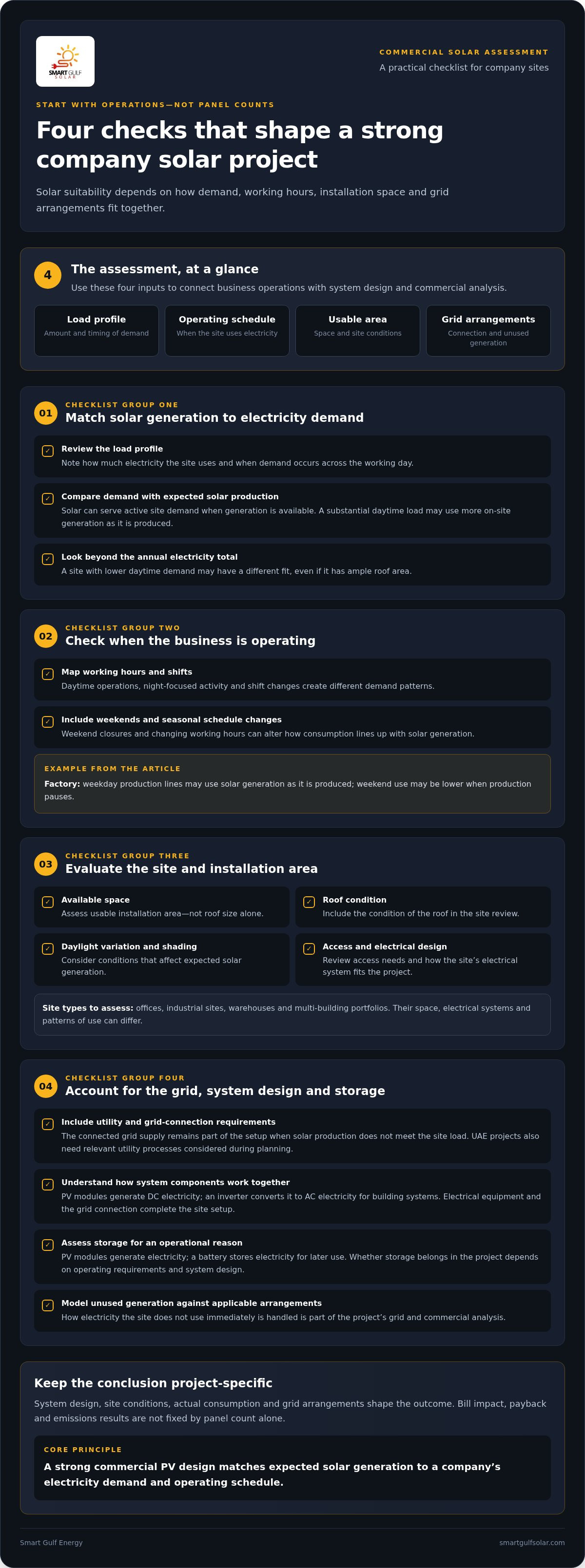
Panel count alone doesn’t show how well solar will support a business. Compare the site’s load profile, meaning the amount and timing of electricity demand, with the periods when the PV system is expected to generate. A business with substantial daytime operations may use more on-site generation as it is produced. A site with lower daytime demand may have a different fit, even if it has ample roof area.
Commercial PV is a site-designed system that matches solar generation to a company’s electricity demand. This definition shifts the assessment from panels per roof to the relationship between generation and operating hours. Review demand across the working day and note how it changes between operating periods before judging the potential fit.
That comparison is the starting point for project planning. It helps establish what the system should support and gives engineering work a clear operational basis. For businesses in the UAE, grid connection is also part of planning, so the relevant utility process needs to be accounted for as the system is developed.
How solar energy can support company operations and energy planning
Solar can reduce a company’s reliance on grid electricity when on-site generation coincides with demand. The key question is not simply how much a system might generate. It’s how generation lines up with the facility’s load and how applicable grid arrangements treat electricity the site doesn’t use immediately.
Where solar generation may fit into daily operations
Facilities with steady daytime electricity use may be able to consume more solar power as it is generated. An office, warehouse, or production site that runs equipment through daylight hours has a different demand pattern from a facility that operates mainly at night. Shift changes matter, too. Weekend closures and seasonal changes in working hours can alter the relationship between generation and consumption.
Consider a factory that runs production lines during the day but pauses on weekends. Weekday solar generation may coincide with equipment demand, while weekend use may be lower. This contrast shows why an assessment should use the site’s operating schedule and load profile, not just an annual electricity total.
For broader business context, the Solar Energy Industries Association’s corporate solar adoption trends report examines company participation in solar. For an individual project, the practical question is how a specific facility’s demand and operating schedule correspond with expected generation.
What solar can and cannot promise a business
On-site generation may lower the amount of grid electricity a business needs to purchase during periods when solar output serves site demand. It doesn’t, by itself, establish a guaranteed bill reduction, payback period, or fixed emissions outcome. Those depend on system design, site conditions, actual consumption, and grid arrangements, including how any unused generation is handled.
Solar may change a company’s electricity bill, but the financial result depends on project-specific conditions. Treat the bill impact as an outcome to model against real demand and applicable arrangements, not as a fixed promise.
Solar generation may also be relevant to company emissions reporting. A business can assess how measured on-site generation relates to its reporting approach, but the system alone doesn’t establish a particular emissions reduction or certification. Reporting treatment depends on the company’s accounting method and applicable requirements.
Build the assessment around four inputs: the load profile, operating schedule, usable installation area, and applicable grid arrangements. Together, these connect operational needs to system design and commercial analysis. For a project-specific view, explore commercial solar PV project development.
Which companies and sites are suited to solar energy?
Solar suitability depends on two things working together: a useful generation area and an operating demand profile that can make use of the electricity. Offices, factories, warehouses, and multi-building businesses can all be assessed, but their roof space, electrical systems, and patterns of use differ. For solar energy for companies, start with a facility-level review rather than an assumption based on business type.
How operating patterns shape solar suitability
A site with steady daytime demand may use more solar generation as it is produced. A facility whose heaviest loads occur outside daylight hours may have a different fit. Load data and operating schedules help engineers understand when electricity is used and inform system sizing. For a portfolio, assess each facility separately: similar buildings may have different demand, usable areas, or grid arrangements.
Business profile | Relevant consideration | Assessment question
Office | Daytime occupancy and building loads | How does electricity demand track the working day?
Industrial site | Equipment loads and shift patterns | When do major processes operate?
Warehouse | Roof area, electrical demand, and operating schedule | Is usable space aligned with on-site demand?
Multi-building portfolio | Facility-by-facility differences | Which sites have suitable demand and infrastructure?
How site conditions shape the project
Roof area is only one part of the assessment. Structural capacity, shading, safe access, electrical infrastructure, and the point of connection all affect the design. Ground-mounted or other configurations may be considered where the available site and project requirements support them. They are options to assess, not automatic alternatives to rooftop installation.
In the UAE, climate and site conditions should be addressed through engineering rather than assumptions about expected output or roof performance. A technical review connects facility demand with usable area, structural considerations, electrical design, and the applicable utility and grid-connection process. A commercial and industrial solar EPC engineering guide can help explain how these factors feed into project design.
For an initial assessment, bring together operating schedules, electricity-use data, site plans, and available building information. This gives the engineering process a practical basis and helps distinguish a site with attractive roof space from one that can support a well-integrated project.
Addressing concerns about solar reliability, grid connection, and storage
Solar output varies with daylight and site conditions, so a PV system shouldn’t be treated as a constant power source. For a grid-connected business, the utility connection remains part of the operating setup. The site can draw grid electricity when solar generation doesn’t meet demand. How the system handles excess generation depends on the applicable grid arrangements.
For solar energy for companies, reliability planning starts by defining what the facility needs to keep operating and when. Grid connection, PV generation, and battery storage play distinct roles. A battery may store electricity for later use, but it isn’t a standard requirement for every solar project, and its presence alone doesn’t guarantee uninterrupted backup.
Can company solar operate when sunlight is limited?
Solar generation falls when daylight is limited and may also vary with site conditions. In a grid-connected system, the site can draw electricity from the grid as needed, subject to its connection and applicable arrangements. A battery may help supply selected loads under a designed operating plan, but backup depends on system configuration, the loads connected, and the energy available in storage.
When does battery storage belong in the assessment?
Assess storage against a defined operational objective. A battery may be considered for peak management or backup power where the project design supports that function. Compare the timing of company loads with solar generation, identify which operations matter most, and decide whether shifting or reserving energy addresses a real requirement. A UAE commercial battery storage guide provides further context for evaluating storage alongside solar.
Battery design must reflect its intended role. Peak management and backup are different operating objectives, and a system configured for one shouldn’t be assumed to deliver the other. Backup planning needs clarity on which equipment or circuits require support and under what conditions. The engineering assessment should translate those requirements into a suitable system design rather than treating storage as an automatic addition.
Grid connection also requires project-specific planning in the UAE. The relevant utility process and requirements depend on project location and system design. Include these considerations in the project assessment alongside site demand and the intended role of any battery. Requirements for one emirate or facility shouldn’t be assumed to apply to another.
Define the operating objective first, then assess solar, grid connection, and storage as parts of one project. Learn about solar and battery storage projects designed around company operating requirements.
How companies can move from solar interest to a defined project
A company solar project moves from operational objectives to technical definition, then through delivery and commissioning. Start by clarifying what the business needs the system to support. Review electricity demand and site conditions, then develop a design around those findings. The delivery sequence includes engineering, procurement, construction, testing, and commissioning, as well as the relevant grid-connection process.
What information helps define a company solar project?
Begin with a clear project brief and facility records. Useful inputs include:
- Facility location and available site or building plans
- Electricity consumption records and operating hours
- Project objectives, such as serving on-site demand or assessing battery storage
- Information about existing electrical infrastructure and grid connection
- Available details on roofs or other potential installation areas
These details connect the company’s objectives to the facility’s actual demand and physical constraints. They inform preliminary design, system scope, and the engineering questions that need to be resolved. For multi-site businesses, collect this information for each facility rather than assuming one site represents the whole portfolio.
What end-to-end solar EPC delivery can include
Once the project is defined, engineering develops the system design and coordinates it with site requirements. Procurement secures project components, construction installs the system, and testing and commissioning verify its operation. Grid interconnection is addressed as part of delivery, with the applicable utility process shaped by the project location and requirements.
Smart Gulf Energy is a Dubai-based solar EPC contractor operating since 2005. Its turnkey scope covers engineering, procurement, construction, testing, commissioning, and grid interconnection. The company manages projects from concept and quotation through delivery, with project scope and commercial outcomes grounded in site-specific engineering rather than generic assumptions.
A guide to solar EPC engineering for commercial and industrial projects can offer further context on the technical and delivery stages. The essential sequence is straightforward: define objectives, assemble facility information, assess the site and demand, develop the design, deliver the system, then test and commission it.
For solar energy for companies, a disciplined assessment turns interest into a project scope that operations and engineering teams can evaluate. A solar PV or battery storage project should begin with its objectives, operating requirements, and site conditions.
Turn your solar assessment into a clear project plan
Solar energy for companies is an operating decision shaped by demand, site conditions, and grid arrangements. A useful assessment looks beyond panel count and compares when a business uses electricity with when solar can generate it. Battery storage is a separate design choice to consider when it supports a defined operational need.
Start with your facility’s electricity records, operating schedule, site information, and project objectives. These inputs help determine whether the site is suitable and shape the design, scope, and commercial assessment. Solar output varies, so grid connection and any storage requirements must reflect how the business needs to operate.
Smart Gulf Energy is a Dubai-based solar EPC contractor operating since 2005. Its end-to-end delivery covers engineering, procurement, construction, commissioning, and grid interconnection, bringing the project through a defined delivery sequence.
Ready to translate your operating requirements into a project scope? Discuss your company solar project with Smart Gulf Energy. A clear assessment is the practical first step toward a well-defined solar project.
Frequently Asked Questions
How does solar energy work for a company?
A company solar PV system converts sunlight into electricity for use at the business site. PV modules generate direct-current electricity, then inverters convert it into alternating current for the building’s electrical systems. A grid-connected system can supply solar power alongside electricity from the grid, with the balance changing as solar output and site demand vary. Battery storage is a separate design option that stores electricity for later use.
Can solar energy reduce a company’s electricity bills?
Solar can reduce the grid electricity a company purchases when on-site generation coincides with its demand. The bill impact depends on system design, site conditions, electricity use, and applicable grid arrangements. A business that uses more power during solar generation may use a greater share of that electricity on site. Treat savings as a project-specific outcome, not a guaranteed amount or fixed payback period.
Is commercial solar suitable for every type of business?
No. Suitability depends on each facility’s electricity demand, operating schedule, usable installation area, structural condition, shading, access, and electrical infrastructure. An office with daytime loads presents a different profile from a site whose main operations happen outside daylight hours. A technical assessment weighs these factors together. Businesses with several locations should assess each facility individually rather than assume one site’s conditions apply across the portfolio.
What happens when a company solar system produces more electricity than the site uses?
How excess generation is handled depends on the system design and applicable utility and grid arrangements. Where export is permitted, electricity may flow to the grid. Export rules and any resulting treatment vary, so a business shouldn’t assume that unused power earns a particular credit. Battery storage may store some generation for later use if it is included in the project design and suits the operating objective.
Does a business need battery storage with solar panels?
No. A grid-connected solar system can operate without a battery, with the site drawing grid electricity when solar output doesn’t meet demand. Storage may suit objectives such as shifting energy use, peak management, or backup power, depending on system design and operating requirements. A battery doesn’t automatically guarantee uninterrupted supply. The assessment should define which loads need support and when, then determine whether storage fits those needs.
How do UAE grid connection requirements affect a company solar project?
Grid connection and approval requirements depend on the project location, relevant utility, and system design. Address these requirements during project development because they shape engineering, interconnection, and delivery planning. For a UAE site, the project assessment should account for the applicable utility process rather than assume the same requirements apply everywhere. Export arrangements also need consideration where the system may send unused generation to the grid.
What information should a company prepare before assessing a solar project?
Prepare the facility location, electricity consumption records, operating hours, and project objectives. Site plans or other available building information can help identify potential installation areas. Include details about existing electrical infrastructure and the grid connection where available. This information gives the assessment a practical starting point: it helps relate demand to operating patterns, identify site considerations, and develop preliminary design and project scope around the facility’s actual requirements.


