

The option that protects cash flow today can limit control over the solar asset tomorrow. In the solar lease vs buy decision, the headline payment is only one part of the equation. Ownership, performance risk, maintenance duties, and the terms for changing or selling a property can all affect a project’s value over time.
Upfront capital and monthly cash flow are useful starting points, but they do not tell the whole story. Compare lifecycle costs, who operates and maintains the system, and how each contract assigns responsibility if performance falls short. Use the same project assumptions for both options, then weigh the resulting costs and responsibilities against your business’s need for control and flexibility.
This guide explains lease and purchase structures, the contract and project factors that can change the financial outcome, and how an EPC partner can carry an owned project from concept and engineering through procurement, construction, testing, and commissioning. Smart Gulf Energy brings technical scope and financing considerations into project planning, giving businesses a clear way to assess ownership and execution together.
Key Takeaways
- Compare solar lease vs buy using the same site, generation, energy-use, and contract assumptions.
- Look beyond upfront capital to recurring payments, asset control, maintenance duties, and performance risk.
- Match the structure to your site plans, capital priorities, and capacity to manage the system over time.
- Review payment schedules, escalation clauses, and performance terms. These contract-specific details can shift the outcome.
- Connect your financing choice to an EPC delivery plan covering engineering, procurement, construction, and commissioning.
Solar Lease vs Buy: What Changes for a Commercial Solar Project?
A commercial solar decision is also an asset decision. When a business buys a system, it owns the equipment, whether it uses available capital or separate financing. With a lease, another party owns the system and the business uses it under a contract, usually in return for scheduled payments. The exact payment structure and allocation of responsibilities depend on the agreement.
In brief: Buying means your business owns the solar asset. Leasing means it uses an asset owned by another party under contract.
The Solar Power Overview outlines the technologies behind solar generation. For a commercial project, the practical question is how ownership and operation fit the facility’s electricity use, site plans, and asset strategy.
How commercial solar leasing and buying differ
With a direct purchase, the business owns the equipment and has more direct control over the asset, subject to applicable project requirements and agreements. Ownership also means making decisions about how the system is managed over time. Financing a purchase can change when cash is paid, but it does not by itself change who owns the system.
A lease separates equipment ownership from the business’s use of the electricity the system generates. The lessor owns the equipment, while the business uses it under the lease terms. Payments may follow a fixed schedule or another agreed structure. Do not assume every lease has the same escalation terms, duration, or end-of-contract options.
A power purchase agreement (PPA) is a different structure. Instead of paying to lease equipment, the customer generally agrees to buy electricity generated by a system owned by another party. A lease payment and a PPA energy charge are not interchangeable. Compare what each contract charges for and how it addresses generation, performance, and operating duties.
Responsibilities also vary by agreement. Monitoring, maintenance, repairs, insurance, and system-performance obligations may be assigned to different parties. Read those allocations alongside the project scope. The label “lease” alone does not establish who handles each task.
Why the comparison matters for UAE businesses
For a warehouse, factory, office, or other commercial facility, the right structure depends on more than a headline payment. Base the comparison on the same site, proposed system, expected generation, electricity-use pattern, and contract period. Then assess how each option fits your capital priorities, internal operating capacity, and property plans.
Location matters in the UAE. Approvals and grid arrangements depend on the project site and applicable authority, so treat them as project inputs rather than assuming they are identical across emirates or facilities. A rooftop with structural constraints, a business with changing operating hours, and a site expected to change use can each lead to a different comparison.
Use the solar lease vs buy analysis to clarify who controls the equipment, who carries specific responsibilities, and how the arrangement fits the organization’s asset strategy. Those answers provide a sound basis for comparing cash-flow options.
How Solar Lease and Purchase Structures Affect Cash Flow and Control
The financial comparison involves more than choosing between a large initial outlay and a recurring charge. A purchase may require upfront capital or separate financing, while a lease typically turns system use into contract payments. Each structure affects cash allocation, decision-making authority, and exposure to operating duties in different ways.
| Factor | Direct purchase | Lease |
|---|---|---|
| Ownership | The business owns the solar equipment. | The lessor owns the equipment; the business uses it under contract. |
| Initial capital | Capital is deployed upfront or through purchase financing. | Initial payment requirements depend on the lease terms. |
| Recurring payments | May include financing payments and ongoing operating costs. | Payments follow the agreed lease schedule. |
| Control | The owner generally has more direct asset control, subject to project requirements and agreements. | Control is shared or limited according to the lease and related agreements. |
| Responsibilities | Ownership-related duties are allocated through project and service agreements. | Maintenance, monitoring, insurance, and performance duties depend on contract terms. |
A headline payment alone cannot show lifecycle value. Compare the full cash-flow profile, expected energy output, operating obligations, and end-of-term position before deciding which structure costs less or fits better.
Cash-flow and capital-allocation trade-offs
A direct purchase can commit capital that might otherwise support inventory, facility upgrades, or other priorities. That opportunity cost matters when the business has competing investment needs, though its importance varies by organization. A lease may preserve more initial capital while creating an ongoing payment obligation. Compare those payments with the expected value of the electricity used or exported under the project’s applicable arrangements.
For a fair model, keep the site and system assumptions consistent across both options. Use the same electricity tariff, expected generation, energy-use profile, degradation assumptions, financing terms, and payment escalations. Purchase economics also depend on how long the business expects to operate the system and how much of its output it can use. Changing these inputs between scenarios makes the comparison less useful.
Ownership, maintenance, and performance responsibilities
Ownership gives the business a direct role in decisions about its asset. A lease places ownership with another party. Neither arrangement automatically assigns every operational risk to one side. The agreement may divide monitoring, preventive maintenance, repairs, insurance, site access, and performance remedies between the parties.
Map each duty to a named party, then check the conditions and limits attached to it. For example, understand how a performance commitment is measured and what remedy applies if the agreed terms are not met. Integrating financing considerations with EPC scope and milestones connects the financial model to delivery planning. Businesses assessing an owned system can review solar EPC project delivery as part of that evaluation.
When Buying or Leasing Solar Fits a Business Better
Neither ownership nor leasing is the automatic choice for every commercial site. The better fit depends on how long the business expects to use the property, where it needs to allocate capital, how much control it wants over the equipment, and who can manage ongoing duties. Treat the solar lease vs buy decision as a match between the project structure and business priorities, not as a contest with one universal winner.
When direct ownership may fit the project
Buying may suit an organization that wants direct oversight of system decisions and expects to operate at the site over the long term. Ownership can fit a facility’s asset strategy when the business has available capital or a defined financing approach and is prepared to manage the responsibilities assigned to it.
Consider a company planning to keep a warehouse in service for many years. If the site is suitable and the project assumptions support ownership, purchasing may give the business more direct control over system changes and operation. The expected time at the property matters because a shorter horizon can change the value of retaining the asset.
When a lease may fit the project
A lease may suit a business that prefers contracted payments and use of the system over direct equipment ownership. But the payment profile alone does not establish flexibility or remove every operating duty. Review the contract duration, any escalation clause, maintenance scope, performance terms, and the options or obligations at the end of the agreement.
Property plans are critical. A company operating from leased premises should consider how the solar contract aligns with its building lease, including what happens if the tenancy ends before the solar agreement. A planned sale, refinancing, relocation, or facility expansion can also raise questions about transfer, consent, removal, or contract changes. The agreement determines how those events are handled.
Quick fit check:
- Buying may fit when asset control, a long site horizon, and a workable capital or financing plan take priority. The business should be ready to oversee the duties assigned to the owner.
- Leasing may fit when retaining more capital for other priorities and following a contracted payment structure matter more than owning the equipment. The contract still needs to fit the site’s plans and operating needs.
These are starting points, not a final verdict. A lease with escalating payments or restrictive transfer provisions may be less suitable than its initial payment suggests. Ownership may be less attractive if the business has competing uses for its capital or uncertain site plans. Model both structures using the same site, energy-use profile, generation assumptions, and evaluation period. Then test how financing, operating responsibilities, and likely property changes affect the result.
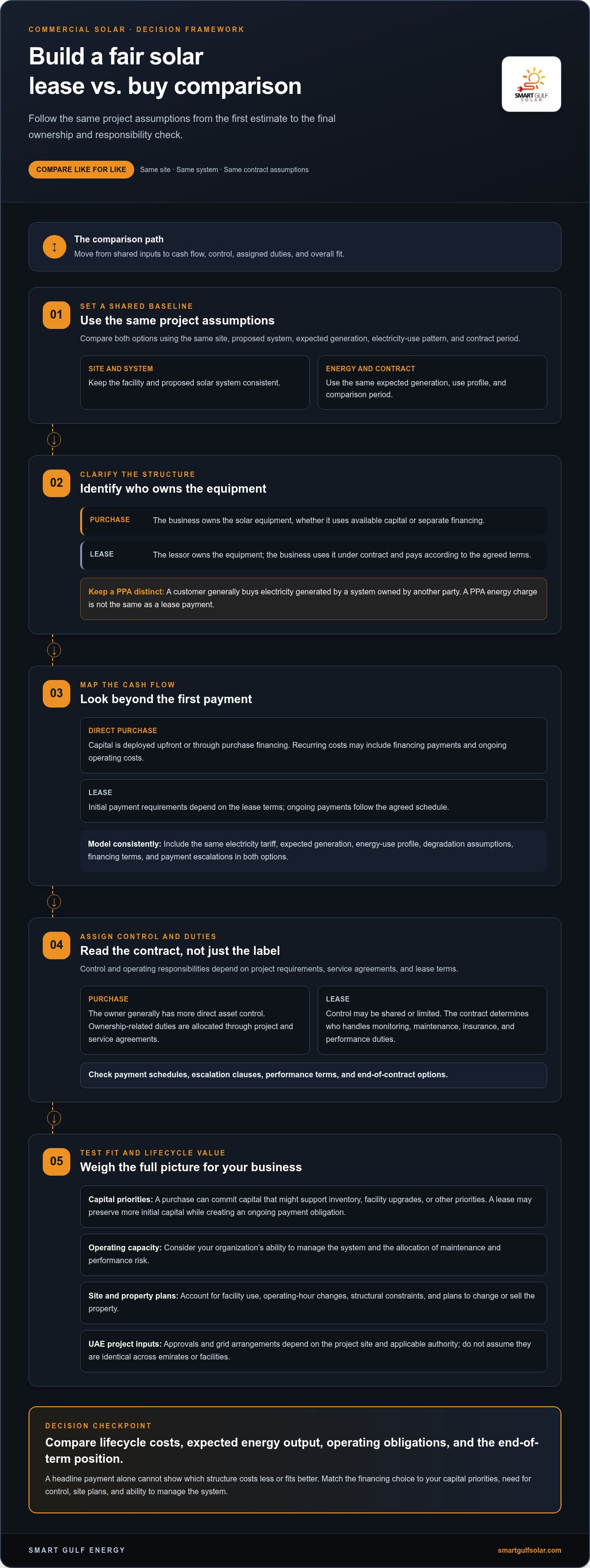
A Practical UAE Framework for Comparing Solar Lease vs Buy
Start with a consistent project baseline. Compare the same facility, system scope, expected generation, electricity-use profile, and evaluation period under both structures. Then test how contract terms, site constraints, and project delivery affect the outcome.
- Define objectives. Set out business priorities first: preserving capital, owning the asset, establishing predictable payments, or keeping flexibility for a planned property change. Record the expected site-use horizon and who will oversee the system.
- Assess the site. Identify the project emirate and the authority relevant to approvals and grid interconnection. Review roof condition, available area, electrical infrastructure, construction and maintenance access, and operating constraints that could affect system design.
- Model both options. Use the same design scope, generation estimate, energy-use assumptions, and comparison period. Include the lease payment profile or purchase financing, expected operating costs, and the treatment of energy not used on site.
- Review the terms. Compare contract duration, payment changes, maintenance scope, performance provisions, insurance duties, transfer rights, and end-of-term treatment. Have qualified advisers review the relevant tax, accounting, and financing treatment for the business and project.
- Validate delivery. Check that the selected structure aligns with engineering scope, procurement, construction access, approvals, testing, commissioning, and grid connection. Reflect project milestones and assigned responsibilities in the model.
Build a like-for-like financial and operational model
Keep the assumptions visible. Use a common set of inputs for system capacity, generation, energy use, tariffs, operating life, and expected degradation. For the lease scenario, show scheduled payments and any escalation. For the purchase scenario, show the capital or financing approach and the operating costs assigned to the owner.
Then run sensitivities. Test how changes in energy use, generation, financing assumptions, or contract duration affect the comparison. The commercial solar ROI and financial modeling guide can help frame project metrics. Qualified financial and tax advisers can assess how the selected structure applies to the business.
Account for UAE site, approvals, and grid connection
Requirements depend on project location and the applicable authority. For a Dubai project, consider DEWA’s role where relevant. Elsewhere, identify the authority governing approvals and interconnection at the site. Do not apply one emirate’s process or assumptions to another project.
Include site findings in the financial comparison. Roof limitations, electrical upgrades, access restrictions, and operating schedules can change design scope and delivery planning. Smart Gulf Energy connects these technical inputs with project financing considerations and EPC milestones. Learn about Smart Gulf Energy’s commercial solar project delivery and how it brings project planning and execution together.
From Financing Decision to Solar Project Delivery
A financing choice becomes useful when it translates into a buildable scope. Ownership and responsibility terms affect who controls design decisions, procures equipment, coordinates construction, and manages the system after commissioning. Align those boundaries before work begins. This gives the business a clearer view of project interfaces, delivery milestones, and obligations that remain after the system is energized.
Translate the chosen structure into an executable project scope
For a purchased system, the business owns the asset, while the project scope defines how engineering, procurement, construction, testing, and commissioning will be delivered. Under a lease, the equipment owner’s and site user’s duties need to align with project documents and operating arrangements. Neither structure removes the need to define responsibility for access, approvals, installation coordination, and system handover.
Smart Gulf Energy delivers solar PV EPC projects from concept and quotation through engineering, procurement, construction, permitting, testing, commissioning, and grid interconnection. The delivery plan connects each stage: engineering establishes the technical scope, procurement follows the design, and construction depends on site readiness and applicable approvals. Testing and commissioning verify the installed system before grid interconnection steps are completed. The commercial solar EPC engineering guide provides additional context on how engineering supports commercial project execution.
Set scope boundaries in practical terms. Identify who prepares design information, coordinates site access, manages approval submissions, supplies equipment, performs testing, and provides operating documentation. Record dependencies and decision points alongside project milestones. Clear responsibility for each task reduces gaps between financing assumptions and the work required to deliver the system.
Set the next steps for a project-level comparison
Move from a general solar lease vs buy comparison to a defined project file. Gather available site drawings, roof and electrical information, electricity-use data, operating schedules, property plans, and the business’s preferred project timing. Add the priorities that will shape the decision, such as retaining control, preserving capital, or planning around a facility change.
Compare financing scenarios against engineering feasibility and operational requirements, not in isolation. A payment structure may look workable on paper but depend on a system size, construction sequence, or site access plan that needs refinement. Smart Gulf Energy can bring project scope, financing considerations, and delivery milestones into one planning sequence, then advance the selected solar PV project through EPC execution.
Explore Smart Gulf Energy’s solar EPC project delivery as you move from financing assumptions to project planning.
Turn the Comparison Into a Project Plan
Turn your preferred structure into a decision your finance, facilities, and operations teams can act on. Set a clear project baseline, document the assumptions that matter, and identify which contract terms or site conditions could change the result. This gives stakeholders a practical basis for approving further project development.
Use the solar lease vs buy analysis to define the structure that fits your business priorities, then connect that choice to an executable scope. A project discussion can bring financial considerations and technical requirements into the same planning process, helping your team move from a comparison on paper toward a defined next step.
Discuss your commercial solar project with Smart Gulf Energy to develop a project-level assessment and delivery plan.
Frequently Asked Questions
Is leasing solar panels better than buying them?
Neither option is automatically better for every commercial site. In the solar lease vs buy comparison, consider how each structure fits your capital priorities and the time you expect to use the facility. For example, a business planning a near-term relocation may weigh contract exit terms heavily, while a long-term site operator may place more value on controlling the asset. Model both options using identical project assumptions before choosing.
Can a business buy solar panels with financing instead of leasing?
Yes. A business can assess a direct purchase supported by financing alongside a lease proposal. Financing does not, by itself, establish who owns or operates the system; the financing and project agreements define those rights and duties. Compare repayment obligations, any security requirements, asset ownership, and responsibility for delivery and operation. Have qualified advisers review the accounting and tax treatment for the project’s jurisdiction and contract structure.
How does a solar lease differ from a power purchase agreement?
A solar lease generally provides contractual use of equipment for agreed payments, while a power purchase agreement generally sets terms for buying electricity generated by a system. The distinction matters for budgeting: a lease payment is tied to the asset-use arrangement, while a PPA charge relates to purchased energy. Contract terms still govern ownership, performance obligations, and maintenance. Review the complete agreement and its legal and financial treatment for the project location.
What happens to a leased solar system when the contract ends?
The contract should state what happens when its term ends. Possible outcomes may include renewal, transfer, removal, or another agreed arrangement, but the system does not automatically become the customer’s property. Before signing, note required notice dates, equipment-condition standards, removal arrangements, and any extension or transfer process. For a commercial facility, align these provisions with the building’s ownership or tenancy timeline so the solar agreement does not create an unexpected transition obligation.
Can a business sell or refinance a property with leased solar panels?
Yes, but the transaction may need to account for the solar agreement. Review whether the contract permits assignment, requires a buyer to assume obligations, or sets conditions involving lender consent or settlement. For example, a sale process may be affected if a transfer depends on another party’s approval. Identify these provisions before entering a long-term arrangement, then obtain legal and financing advice tailored to the property transaction and agreement.
Who is responsible for maintaining a leased commercial solar system?
The lease and related project agreements determine who handles maintenance. Look for clear assignments covering performance monitoring, inspections, repairs, insurance, and responses to equipment faults. Also check what reporting is provided, which conditions are excluded, and what remedy applies if a service or performance commitment is not met. A facilities team can use this responsibility map to plan internal staffing and avoid assuming every maintenance task is included.
Can a commercial solar project include battery storage?
Yes. A commercial solar project can be assessed with battery storage when the site’s operating profile supports it. Compare solar-only and solar-plus-storage designs as separate cases, since a battery changes the technical scope and operating assumptions. For example, a facility with a defined need to use stored energy later may assess a different configuration from one focused solely on daytime solar generation. Smart Gulf Energy delivers battery storage projects, including integration with new solar PV arrays.


