

The financing structure is only as strong as the project it has to fund. For clean energy project financing UAE, choosing between self-funding, corporate debt, project finance, or a third-party arrangement is only one decision. Permitting, grid connection, technical scope, and delivery responsibilities can all determine whether the capital plan is workable.
It’s understandable to focus first on the source of capital. Lenders and investors also need a clear view of project readiness, expected cash flows, key risks, and how those risks will be managed. Gaps in feasibility work or unclear delivery roles can slow progress before financing is arranged.
This guide compares funding routes by ownership, control, and risk allocation, then outlines the information used to assess bankability. It also maps a practical path from feasibility and preliminary engineering through project structuring and delivery, with solar PV and battery storage examples relevant to the UAE. The goal is a financing route built around a project that can be executed.
Key Takeaways
- Compare self-funding, corporate debt, project finance, and third-party arrangements by ownership, control, repayment, and risk allocation.
- Assess clean energy project financing UAE readiness by assembling the technical, site, permitting, grid, contract, and financial information decision-makers need.
- Use revenue assumptions, operating costs, and sensitivity analysis to test whether the financial model can withstand changing conditions.
- Select a financing route that fits your ownership goals, balance-sheet capacity, project cash flows, and delivery responsibilities.
- Connect feasibility and preliminary engineering to financing, procurement, construction, and commissioning through a defined EPC scope and clear accountability.
Clean Energy Project Financing in the UAE: What It Covers
Clean-energy project financing defines how an asset will be funded, who will own and control it, how project risks are allocated, and how repayments or investor returns will be generated. It is broader than paying an EPC contractor against agreed milestones. Milestone payments cover contracted delivery work; financing determines how the project’s capital is raised and repaid over time.
Project finance funds an asset as a defined venture, with repayment linked primarily to its project cash flows; an equipment purchase pays for specified goods or work under a contract. This distinction matters for clean energy project financing UAE because a solar PV installation or battery storage system can be structured differently according to its purpose, ownership, and revenue model. Climate finance encompasses investments in sustainable energy.
Which UAE clean-energy projects may need structured financing?
A commercial rooftop solar project may be funded by the building or business owner, with value tied to energy used on site. A utility-scale renewable project involves a larger asset and may depend on contracted sales or another defined revenue arrangement. Battery storage may support an operating site or form part of a broader energy project, so its funding case depends on how it will be used and create value.
Project size alone doesn’t determine the structure. Ownership plans, balance-sheet capacity, expected revenues, operating purpose, and delivery responsibilities all shape the funding need. Project development and financing support can connect feasibility, preliminary engineering, and structuring, but it cannot guarantee that a lender or investor will commit capital. Terms depend on project scope, counterparties, and applicable UAE requirements, which can vary by emirate and project type.
Who participates in a financed project?
The asset owner holds or controls the project. The developer advances its design and structure. The EPC contractor engineers, procures, and constructs the asset under an agreed scope. A lender provides debt under its terms; an investor contributes capital in return for an agreed financial interest. An offtaker purchases power or another contracted project output where that arrangement applies.
Roles vary with the funding route. Under balance-sheet funding, the project company or business typically borrows or invests using its own financial capacity. Project-level financing focuses on the asset’s contracts, cash flows, and allocated risks. One party may hold several roles, but each responsibility should be explicit.
For applicable Dubai grid-connected projects, DEWA may be relevant to the connection process. Build permitting and interconnection planning into development, since requirements depend on the project and current rules.
Compare Clean Energy Financing Structures Available to UAE Projects
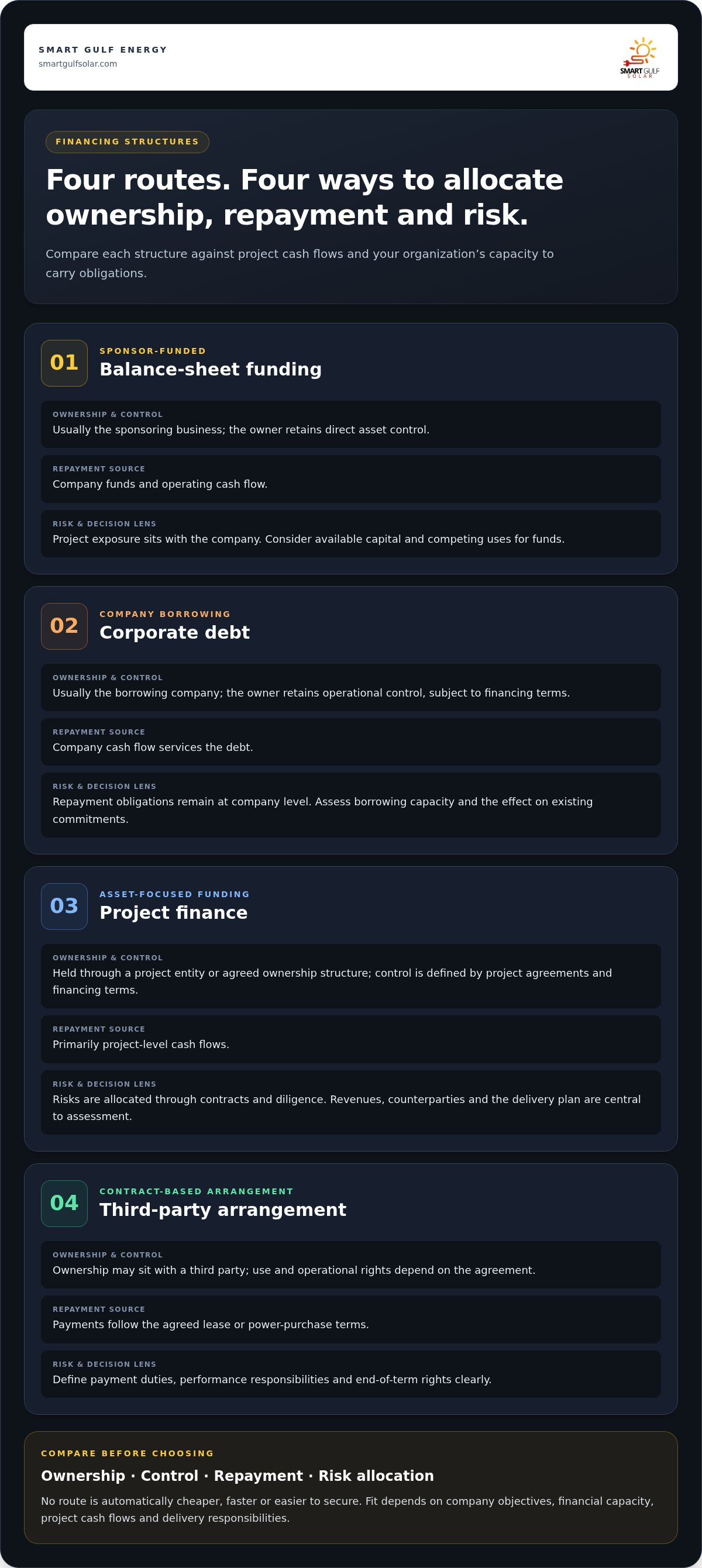
Each structure assigns ownership, repayment, control, and risk differently. For clean energy project financing UAE, compare the routes against project cash flows and your organization’s capacity to carry obligations. The International Renewable Energy Agency (IRENA) covers renewable energy investment and policy frameworks in the Middle East. That regional context does not determine a project’s financing terms; diligence and counterparties do.
| Structure | Ownership | Repayment source | Control | Risk allocation and decision considerations |
|---|---|---|---|---|
| Balance-sheet funding | Usually the sponsoring business | Company funds and operating cash flow | Owner retains direct asset control | Project exposure sits with the company. Consider available capital and competing uses for funds. |
| Corporate debt | Usually the borrowing company | Company cash flow services debt | Owner retains operational control, subject to financing terms | Repayment obligations remain at company level. Assess borrowing capacity and the effect on existing commitments. |
| Project finance | Held through a project entity or agreed ownership structure | Primarily project-level cash flows | Defined by project agreements and financing terms | Risks are allocated through contracts and diligence. The project’s revenues, counterparties, and delivery plan are central to assessment. |
| Third-party arrangement | May sit with a third party, depending on the contract | Payments follow the agreed lease or power-purchase terms | Use and operational rights depend on the agreement | Payment duties, performance responsibilities, and end-of-term rights need clear definition. |
When does balance-sheet funding or corporate debt fit?
These routes may suit sponsors that want direct ownership and have the capacity to fund the asset or service borrowing at company level. Balance-sheet funding uses the organization’s available capital; corporate debt adds repayment obligations that may affect wider financial flexibility. Neither route is automatically cheaper, faster, or easier to secure. The choice depends on company objectives, financial capacity, and project needs.
How do project finance and third-party arrangements differ?
Project finance focuses diligence on the asset’s cash flows, contracts, and allocation of construction, operating, and revenue risks. A lease and a power-purchase arrangement are not interchangeable: a lease generally sets payments for use of an asset, while a power-purchase agreement sets payment for energy supplied. Ownership, maintenance duties, performance terms, and termination rights depend on the contract. For a closer comparison, read the solar lease versus direct-buy comparison.
Lender appetite and structure depend on project-specific diligence and counterparties, not just the technology. Map ownership, cash flows, contract obligations, and delivery responsibilities before choosing a route. Explore clean-energy project development and financing support as a path from project assessment to a defined structure.
What Makes a UAE Clean Energy Project Finance-Ready?
Finance readiness is built from evidence, not intent. A lender or investor needs a coherent view of the asset, its site, the route to construction, and the cash flows expected to support it. Bankability combines credible cash flows with controlled project risks.
For clean energy project financing UAE, distinguish national context from project approvals. UAE-wide strategies frame the broader direction: the UAE Ministry of Economy & Tourism outlines the nation's commitment to sustainable development goals, including clean energy. Permitting and grid-connection steps depend on the emirate, project type, and relevant authority. Map the current requirements for the specific site and asset.
- Feasibility: Document the project purpose, site conditions, constraints, and expected benefits.
- Technical design: Set out preliminary engineering, system scope, production assumptions, and key interfaces.
- Site and approvals: Show site control and track applicable permits, approvals, and grid-connection work.
- Contracts: Identify roles and obligations under offtake, supply, EPC, and operations arrangements, where applicable.
- Financial model: Record revenue assumptions, operating costs, funding needs, and repayment or return expectations.
Which technical and commercial documents support diligence?
Build a document set that lets reviewers trace each key assumption to project evidence. Feasibility findings and preliminary engineering should align with the proposed scope and production estimates. Contract terms should show who supplies energy or equipment, who delivers construction, and who operates the asset. Where an offtake agreement supports revenue, reflect its terms in the model rather than treating revenue as a general expectation.
Use transparent inputs for energy production, revenue, operating costs, and timing. Sensitivity analysis tests how the financial case responds when those assumptions change. A clear record helps reviewers distinguish supported projections from unresolved items.
How do approvals and grid connection affect project readiness?
Permitting and interconnection are project workstreams, not automatic outcomes. Map the applicable authority, required submissions, dependencies, and outstanding decisions alongside the engineering and financing schedule. In Dubai, DEWA is relevant for applicable grid-connected projects, but process details depend on the project and current requirements. See the DEWA Shams permitting and grid-connection guide for Dubai-specific context.
Close gaps early. Align site rights, design, contracts, approvals, and model inputs before treating the financing case as complete.
How to Select a Financing Route for Your UAE Project
Choose a structure by working from project objectives to delivery obligations. For clean energy project financing UAE, the right route depends on what the sponsor wants to own, how it can repay capital, and which risks it is prepared to carry. No structure is the right fit without project-specific evidence.
Which questions should guide the financing decision?
Start with the desired outcome. Is the priority direct asset ownership, preserving capital for other uses, predictable payments, or separating project risk from the sponsor’s wider balance sheet? Then assess whether feasibility, engineering, site control, permits, counterparties, and grid work are mature enough to support a meaningful financing comparison.
A solar-only scope and a solar-plus-storage scope can require different diligence. Storage adds questions about its operating purpose, dispatch assumptions, interaction with the solar system, and how its value appears in the project model. Keep the technical scope aligned with the financial case.
- 1. Define objectives. Record ownership preferences, capital constraints, control needs, and risk appetite.
- 2. Assess the asset. Confirm project scope, development maturity, counterparties, and delivery responsibilities.
- 3. Compare structures. Evaluate balance-sheet funding, corporate debt, project-level financing, and third-party arrangements against those objectives.
- 4. Test assumptions. Model project-specific generation, demand, operating costs, revenues, and repayment scenarios.
- 5. Assign risks. Clarify who carries construction, performance, operating, payment, and interface responsibilities.
How should stakeholders compare proposals and assumptions?
Put proposals side by side. Compare total payment obligations over the contract term, ownership and control rights, conditions to funding, risk allocation, and each party’s responsibilities. A lower initial cash requirement may come with different long-term payments or less control, so assess the full obligation rather than one headline term.
Test the financial case against realistic project scenarios. For a solar asset, examine how changes in generation or site demand affect expected cash flows. For solar paired with storage, also test the assumptions that drive storage use and operating costs. Record the source of each input and distinguish documented figures from estimates.
Keep the comparison grounded. Don’t assume a particular UAE incentive, interest rate, return, or standard term applies without project-specific evidence. The decision rule is straightforward: match ownership to your control goals, repayment to dependable cash flows, and risk allocation to your capacity to manage it.
Bring feasibility, preliminary engineering, and financing assumptions into one project view. Review clean-energy project development and financing support as you shape a route from assessment to delivery.
From Financing Structure to Clean Energy Project Delivery
A financing plan must connect to a buildable scope. The sequence moves from feasibility and preliminary engineering to financing arrangements, procurement, construction, testing, and commissioning. Keep assumptions consistent across each stage, including asset scope, interfaces, responsibilities, and timing. This alignment helps decision-makers assess what the capital will fund and how the project will reach operation.
How can integrated project development support execution?
Coordinate development work before procurement begins. Feasibility defines the project case; preliminary engineering turns it into a technical scope; financing arrangements shape the capital plan; project management connects decisions to delivery. Smart Gulf Energy’s project development and financing services support this pathway, alongside solar PV EPC delivery from engineering and procurement through construction, testing, and commissioning.
A defined EPC scope records deliverables, exclusions, interfaces, testing requirements, and accountability. It also gives funding assumptions a practical reference point: the equipment and work being financed, the party responsible for each interface, and the checks required before handover. For more detail on commercial project scope, see this commercial solar EPC engineering guide.
For clean energy project financing UAE, this connection matters. A financing structure cannot remove delivery risk, but a clear scope and coordinated responsibilities make that risk visible and manageable. Keep the technical, commercial, and delivery plans aligned as the project advances.
When should battery storage enter the financing plan?
Include storage in the project case when the operating objective calls for it, such as peak shaving, backup power, or integration with solar generation. Define that objective first. Then align system design and sizing with the site’s demand profile and intended operation, and reflect the related assumptions in the financial model. Avoid treating storage as an add-on without a defined role.
Storage changes the project scope, technical interfaces, operating plan, and diligence requirements. Bring those factors into project development and financing discussions early, so the funding case reflects the asset that will actually be delivered. For additional context, read the UAE commercial battery storage guide.
Smart Gulf Energy connects feasibility, structuring, and EPC delivery for clean-energy assets. Discuss your project scope and delivery requirements to define the next practical step.
Move from Financing Plan to Project Execution
A workable funding route starts with clear priorities: who owns the asset, where repayment comes from, and how project risks are controlled. Compare structures against those priorities, then support the preferred route with a credible technical scope, documented assumptions, and a delivery plan that accounts for permitting and grid connection.
For clean energy project financing UAE, keep financing and execution connected. Feasibility and preliminary engineering should inform the capital structure, while a defined EPC scope links procurement, construction, testing, and commissioning to the asset being funded.
Smart Gulf Energy has operated since 2005 and provides project development and financing services for clean-energy assets, alongside end-to-end solar EPC capability from engineering through commissioning. This brings project planning and delivery into one practical pathway, without presuming a financing outcome.
Discuss your clean energy project with Smart Gulf Energy to consider the project scope, development requirements, and next steps. With a clear structure and coordinated delivery plan, you can move forward with greater confidence.
Frequently Asked Questions
What is clean energy project financing?
Clean energy project financing is the process of funding an asset and defining its ownership, repayment, and risk allocation. In clean energy project financing UAE, the structure may draw on a sponsor’s capital, corporate borrowing, project-level funding, or a third-party arrangement. It goes beyond paying EPC contract milestones, which cover contracted delivery work. Financing decisions depend on project scope, expected cash flows, counterparties, and delivery responsibilities.
What financing options are available for clean energy projects in the UAE?
Common structures to assess include balance-sheet funding, corporate debt, project finance, and third-party arrangements such as leases or power-purchase agreements. They differ in who owns the asset, where repayment comes from, who controls operations, and how risks are divided. These structures will not necessarily suit every project. The fit depends on project evidence, sponsor capacity, contracts, and financing counterparties.
How does project finance differ from corporate financing?
Project finance assesses repayment primarily against the cash flows and contracts of a defined project, with risks allocated through project agreements. Corporate financing relies more directly on the borrowing company’s balance sheet and wider ability to repay. The distinction affects which financial information matters most and where obligations sit. In either case, lenders or investors may assess the sponsor, technical scope, counterparties, contracts, and project risks before determining terms.
What documents are needed to finance a solar project in the UAE?
Prepare feasibility findings, preliminary engineering, site-control information, production assumptions, and a defined technical scope. Include relevant permitting and grid-connection records, plus offtake, supply, EPC, and operating contracts where applicable. The financial model should show revenue assumptions, operating costs, funding needs, and repayment expectations, with inputs documented and traceable. The precise diligence package depends on the project, financing structure, emirate, relevant authority, and counterparties involved.
Can a battery storage project be financed alongside solar in the UAE?
Yes, solar and battery storage can be assessed as a combined project, provided the technical and financial case reflects how the system will operate. Define the storage objective, such as solar integration, peak shaving, or backup power, then connect it to system design, expected use, operating costs, and cash-flow assumptions. The financing assessment should account for the combined scope, contracts, interfaces, and delivery responsibilities rather than treating storage as an undefined add-on.
How long does clean energy project financing take in the UAE?
There is no single timeline that applies to every project. The process depends on the completeness of feasibility and engineering, site control, permits, grid connection, contracts, financial modelling, and the diligence required by counterparties. Unresolved scope or approval dependencies can affect progress. Build a project-specific schedule that tracks financing review alongside development and delivery workstreams, and verify current requirements with the relevant emirate-level authorities.
Does DEWA approval guarantee financing for a Dubai solar project?
No. DEWA approval or a grid-connection decision addresses applicable project and utility requirements; it does not determine whether a lender or investor will provide financing. Financing parties assess the project’s cash flows, sponsor capacity, contracts, technical design, delivery plan, and risk allocation. Treat utility approvals and financing diligence as linked but separate workstreams, and confirm the current DEWA process for the specific project type.
How can an EPC contractor support clean energy project financing?
An EPC contractor can help define the engineering scope, procurement plan, construction responsibilities, interfaces, testing, and commissioning requirements. Clear delivery information helps align the project budget and technical assumptions with the asset being financed. Smart Gulf Energy also provides project development and financing services for clean-energy assets, connecting feasibility and preliminary engineering with project structuring and delivery planning. This support can strengthen project preparation, but it cannot guarantee a financing commitment.


