

A solar estimate based on a generic price per kilowatt can miss costs that matter on your site. A practical solar project cost estimate UAE starts with the roof or land, load profile, system scope, and delivery requirements, not a headline rate.
Published cost ranges can help frame an early discussion, but they cannot account for your building, operating pattern, or project boundaries. A useful budget separates the main cost categories, records the assumptions behind each one, and identifies what information is needed to refine the estimate. This gives your team a clearer basis for internal review without confusing a preliminary budget with a delivery-ready EPC quotation.
This guide explains how to structure a UAE solar budget, assess the factors that shape project scope, and prepare the inputs an EPC contractor needs to develop a quotation. It also shows how engineering, procurement, permitting, construction, testing, and commissioning fit into one delivery pathway. Smart Gulf Energy provides end-to-end solar EPC services, from concept and quotation through grid interconnection.
Key Takeaways
- Build a solar project cost estimate UAE around your site, system capacity, grid connection, and delivery scope rather than relying on a standalone price-per-kilowatt figure.
- Separate PV equipment, electrical works, civil or structural works, and grid-interface costs so each budget line has a clear basis.
- Compare estimates consistently by aligning capacity, equipment, installation, approvals, exclusions, and key assumptions.
- Use a planning template to record quantities, specification basis, inclusion status, action owners, risks, and review status.
- Trace how site review and engineering develop the estimate into a defined EPC scope, followed by procurement, construction, testing, commissioning, and grid interconnection.
What drives a solar project cost estimate in the UAE?
A solar project cost estimate UAE is a planning model for the work, quantities, assumptions, and risks currently understood for a specific project. It supports budgeting and internal decisions, but it is not a guaranteed final contract amount. Its reliability improves as the site, design, and delivery boundaries become clearer.
A UAE solar estimate is useful only when it reflects the site, electrical connection, and work required to deliver and commission the system. Capacity matters, but it does not tell the full story. Two systems with similar capacity may need different designs, access arrangements, structural work, utility interfaces, and approval coordination.
Keep the main scope groups visible rather than blending them into one figure:
- Equipment: PV modules, inverters, mounting systems, and other specified system components.
- Engineering: design development, site assessment, electrical studies, and project documentation.
- Construction: installation, electrical works, and required civil or structural work.
- Approvals and connection: permitting coordination and grid-interface work, based on the project’s location and requirements.
- Testing and commissioning: system checks, functional testing, and preparation for operation and interconnection.
This breakdown makes inclusions and exclusions easier to review. It also gives decision-makers a sound basis for comparing scope instead of treating a capacity figure as a complete budget. For context on the UAE’s solar development and broader energy landscape, see Solar power in the United Arab Emirates.
How project scale and site conditions shape the budget
Rooftop projects depend on usable roof area, access routes, shading, and structural constraints. A carport adds a support structure and construction interface, while a ground-mounted installation requires its own site layout and civil considerations. These differences affect design quantities and construction scope, not just system capacity.
Test early assumptions against site survey findings and load data. A survey can clarify access and physical constraints; consumption information helps size the system around how the facility uses electricity. Together, they replace broad estimates with project-specific inputs.
What a preliminary estimate can and cannot tell you
A preliminary estimate gives teams a structured basis for planning, comparing scope, and deciding what information to gather next. It can identify likely work packages and document assumptions, but it cannot settle every design quantity before site validation and engineering.
As the design develops, equipment selection, cable routes, mounting details, structural requirements, and grid-interface scope may change. Treat the early figure as a planning reference, then update it as evidence replaces assumptions. The same progression underpins a commercial EPC scope, as explored in the guide Solar EPC Contractor Dubai: The Commercial & Industrial Engineering Guide.
Build the estimate: map every solar project cost category
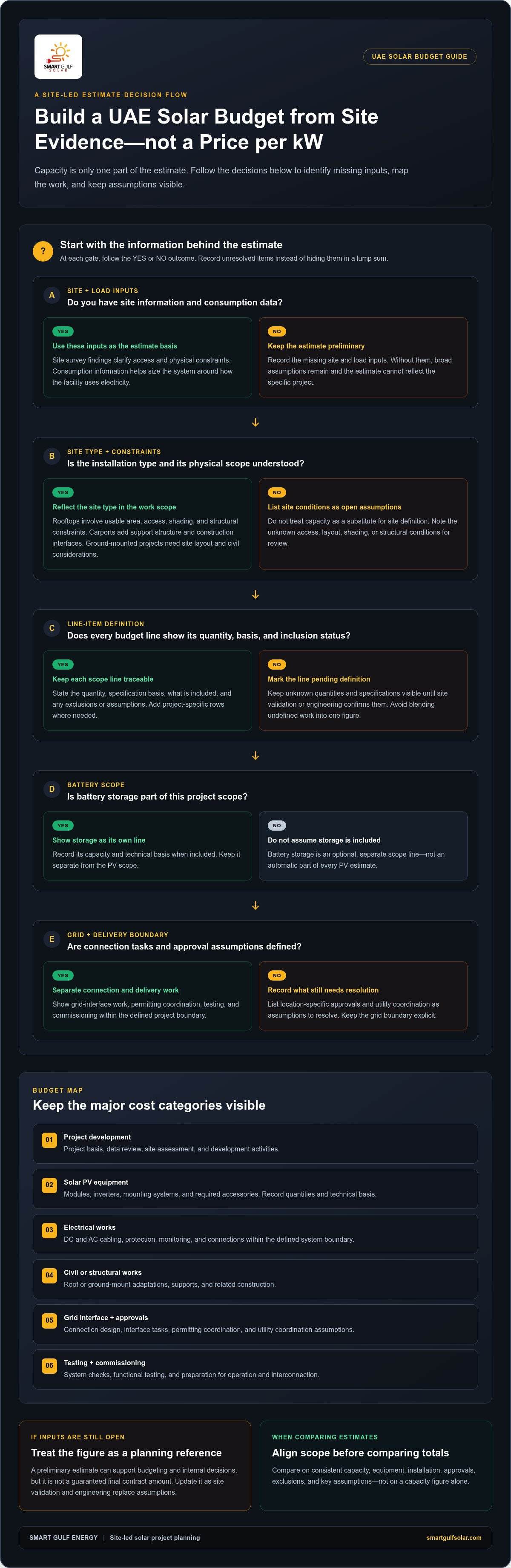
A usable solar project cost estimate UAE is built from traceable scope lines, not a single lump sum. Give each line a quantity, specification basis, inclusion status, and assumption or exclusion. This lets finance, facilities, and engineering teams see what the estimate covers and where further site information could change it.
Use this worksheet structure as a starting point. Add project-specific rows where needed, and mark each item as included, excluded, or pending definition.
- Project development: project basis, data review, site assessment, and development activities. Record the information available and any outstanding inputs.
- Solar PV equipment: modules, inverters, mounting, and required accessories. Record quantities and the technical basis; avoid naming brands or fixed specifications before design data supports them.
- Electrical works: DC and AC cabling, protection, monitoring, and connections within the defined system boundary. State the assumed route or extent and note exclusions.
- Civil or structural works: roof or ground-mount adaptations, supports, and related construction. Identify the physical condition assumed and the work included.
- Grid interface: connection design and interface tasks. Define the project boundary and list location-specific approvals or utility coordination as assumptions to resolve.
- Battery storage: list this as a separate optional scope line, with its own capacity and technical basis when included. Do not treat storage as an automatic part of every PV estimate.
Core solar PV and balance-of-system line items
Break equipment into components rather than grouping it under “solar package.” For each item, record the quantity, specification basis, inclusion status, and exclusions. For example, a cabling line should state which connection it covers, while a monitoring line should distinguish the defined monitoring scope from other site systems. Keep assumptions visible until engineering confirms the design.
Delivery, approvals, and commissioning allowances
Separate delivery effort from hardware. Engineering, project management, procurement, installation, and quality checks each need a defined allowance and assumption. Identify the permitting and grid-connection tasks relevant to the site’s location, rather than treating approvals as identical across every project. This makes responsibilities easier to review and assign.
Close the worksheet with testing, commissioning, and handover documentation. Define the intended checks, records, and acceptance scope so completion has a clear basis. A turnkey EPC pathway connects these steps from concept and quotation through engineering, procurement, construction, DEWA permitting, testing, commissioning, and grid interconnection. For a project-specific estimate, develop the solar EPC scope around the site and defined work packages.
Before circulating the budget, check every row for an owner, an assumption, and a status. Keep unresolved inputs visible instead of hiding them inside a contingency or broad equipment category. This gives the next estimate revision a clear starting point.
Compare UAE solar estimates by scope, assumptions, and risk
A lower total does not automatically represent a more efficient design. It may reflect a different capacity basis, narrower installation scope, or work left outside the estimate. Compare scope line by line before judging the figures. A meaningful review shows what each estimate assumes, includes, and leaves open.
Use a side-by-side comparison like this. Replace the prompts with project information, and label each entry as confirmed, provisional, or awaiting engineering.
| Comparison item | Estimate A | Estimate B | Review check |
|---|---|---|---|
| Capacity basis | Design capacity and sizing basis | Design capacity and sizing basis | Are both based on the same usable area and operating requirements? |
| Equipment scope | Included equipment and technical basis | Included equipment and technical basis | Are components and exclusions defined consistently? |
| Installation scope | Installation and site work included | Installation and site work included | Are access, structural work, and electrical modifications treated alike? |
| Approvals and connection | Approval and grid-interface responsibilities | Approval and grid-interface responsibilities | Are permitting, interconnection, testing, and commissioning assigned? |
| Exclusions and risk | Excluded or unresolved items | Excluded or unresolved items | What action or evidence is needed to close each item? |
Two totals are comparable only when their underlying conditions align. Match usable area, design capacity, connection point, and operating requirements. Then compare responsibility for testing, commissioning, and grid interconnection. Record each assumption’s date, information source, and maturity, such as site-verified, client-provided, or pending design review.
Which assumptions make two estimates comparable?
Check the basis before comparing the outcome. If one estimate uses confirmed load data and the other relies on an early capacity target, they represent different stages of definition. Record the input and its source beside the assumption. This helps reviewers distinguish scope differences from pricing differences without treating either figure as a final contract amount.
How to identify exclusions and cost uncertainty
Mark structural upgrades, electrical modifications, and access requirements as included, excluded, or unresolved. Separate known quantities from provisional allowances and items awaiting engineering confirmation. Add a risk-and-action column to identify each uncertainty, the information needed, and who is responsible for resolving it. Do not bury open scope inside a single total. A validated survey or design may change quantities and scope, so the estimate can change as its basis becomes more complete.
If battery storage is part of the project, compare its scope separately from PV, including its assumptions and open design items. The guide UAE Battery Energy Storage: Commercial BESS Guide 2026 provides further context for reviewing commercial storage scope.
Use this solar project cost estimate template for UAE planning
Make the worksheet a live project record, not just a total. Start with the project basis, add site and load data, then build scope lines and record assumptions, risks, and review status. A well-structured solar project cost estimate UAE gives each stakeholder a clear view of what is known, what remains open, and who owns the next action.
Use these fields for every scope line: Category | Scope item | Quantity | Specification basis | Inclusion status | Assumption or risk | Owner of action | Review status. Mark status as preliminary, validated, or approved. Preliminary means an input is based on early information; validated means it has been checked against site or engineering data; approved means the responsible project stakeholders have accepted it for the current estimate revision. These labels describe information maturity, not fixed prices.
- Project basis: site location, intended system purpose, target capacity or sizing basis, intended grid connection, and whether battery storage is under consideration.
- Site data: available roof or land information, current electrical drawings, access constraints, and known structural or electrical considerations.
- Load and objectives: energy-use data, operating schedule, and project objectives supplied by the asset team.
- Scope lines: list each work package separately, then fill in its quantity, specification basis, inclusion status, action owner, and review status.
- Assumptions and risks: record missing information, possible scope changes, the action needed to resolve each item, and its responsible owner.
Information to gather before completing the worksheet
Collect the location, available roof or land information, and current electrical drawings first. Add energy-use records and operating schedules so the project basis reflects how the asset runs, not just its available area. State the intended grid connection and whether storage is being considered. If an input is unavailable, mark it as open and assign an owner instead of filling the gap with an unsupported assumption.
The minimum information needed to improve an early estimate is the site location, usable area, current electrical drawings, energy-use and operating data, project objectives, and intended connection approach.
How to update the estimate as engineering advances
As design work progresses, replace preliminary assumptions with surveyed measurements and engineered quantities. Keep a revision log with the date, changed scope, reason for the change, related approval or exclusion, and decision owner. This creates a traceable record for internal review and helps explain why the estimate has changed between revisions.
Keep financing and return-on-investment calculations separate from the capital-scope estimate. They use different assumptions and answer different questions. First establish the defined project scope; then assess its financial performance using the appropriate commercial inputs.
Build the next estimate revision around your project data and documented scope with a project-specific solar EPC estimate.
Turn the estimate into a UAE solar EPC project proposal
A planning estimate becomes a project proposal when assumptions are tested against the site and translated into a defined scope. The next steps are to review project data, assess site conditions, develop the engineering, confirm quantities and responsibilities, then issue a quotation against the resulting scope. The proposal should show what EPC delivery includes and identify any unresolved inputs that still affect the project basis.
This transition matters. A solar project cost estimate UAE can guide internal budgeting, but the quotation must be grounded in a deliverable design and clearly bounded work. Site findings, engineering decisions, and approval requirements can refine the scope before it becomes a contract basis.
What Smart Gulf Energy brings to estimate development
Smart Gulf Energy connects concept development and quotation with engineering, procurement, construction, testing, and commissioning as one EPC pathway. This gives project teams a coordinated route from early scope definition to grid interconnection, with delivery stages considered together rather than as disconnected tasks. Smart Gulf Energy serves residential, commercial, and utility projects.
For Dubai projects, DEWA permitting and grid interconnection form part of the delivery scope where applicable. Verify the relevant requirements for the project and location as the proposal develops. Make each responsibility explicit, including who coordinates submissions, responds to technical requirements, and carries out testing and handover activities.
To move from a planning estimate toward a defined EPC scope, start a solar project conversation with Smart Gulf Energy.
Prepare a clear project brief for the next step
Bring the site facts and open decisions into one concise brief. Include the location, roof or land information, available electrical drawings, energy-use and operating data, project objectives, intended connection, and known physical or operational constraints. Note whether battery storage is being considered and identify any information the asset team still needs to provide.
- Site and drawings: summarize available layouts, electrical records, and known access or structural constraints.
- Load and objectives: document operating patterns and the outcomes the project is intended to support.
- Open assumptions: list items requiring site validation, engineering development, or approval coordination.
- Scope decisions: record inclusions, exclusions, action owners, and the status of each decision.
Keep the brief updated as the project advances. The EPC team can use it to review the site, develop engineering, refine quantities, and prepare a quotation that defines scope, interfaces, and responsibilities. After the scope is established, procurement and construction follow the agreed design. Testing and commissioning verify the installed system, with grid interconnection and handover addressed within the defined project pathway.
A clear estimate does not remove project uncertainty. It makes assumptions visible, assigns actions, and creates a disciplined starting point for engineering and delivery.
Move from budget alignment to a defined project decision
Use your solar project cost estimate UAE as a decision tool, not just a spreadsheet figure. Give stakeholders a shared basis for deciding what must be validated, which scope choices need approval, and when the project is ready for formal quotation. This creates a practical handoff from budget planning to project definition.
Before the next review, assign owners to unresolved inputs and set a decision point for revisiting the estimate. That keeps open questions visible and helps your team assess changes against the same project objectives. A disciplined process turns uncertainty into defined actions.
Smart Gulf Energy connects project planning with solar EPC delivery. Start a solar project discussion with Smart Gulf Energy to shape the next step around your site and requirements.
Build the scope with clarity, then move forward with confidence.
Frequently Asked Questions
How much does a solar project cost in the UAE?
There is no single project cost that applies across the UAE; a useful budget depends on the defined system and delivery scope. For a meaningful solar project cost estimate UAE, set the capacity basis, describe the site, and identify whether the estimate covers engineering, installation, connection work, and commissioning. Published examples can offer early context, but use them only as orientation. Replace broad assumptions with site and design inputs as they become available.
What information is needed for a UAE solar project cost estimate?
Start with site and load information, then add the project’s intended outcome and known constraints. Include the latest available electrical drawings and their revision date so the estimate uses current records. If the facility has distinct operating periods, note them alongside energy-use data. This helps the project team identify missing or inconsistent inputs early. Record gaps as open items with an action owner rather than treating them as confirmed conditions.
Does a solar project cost estimate include DEWA approval?
It should clearly state whether permitting coordination and grid-connection tasks are included, excluded, or still to be defined. For a Dubai project, identify the anticipated DEWA-related responsibilities and verify current DEWA and Shams Dubai requirements during project development. Do not assume an equipment-focused estimate covers application work, technical submissions, or grid-interface activities. Naming the responsible party for each task helps prevent gaps between the proposed system scope and the connection process.
Why do solar project estimates differ for similar system capacities?
Similar capacity does not mean identical design or delivery work. For example, one facility may have electrical equipment close to the proposed connection point, while another may need a different cable route or changes to existing infrastructure. Estimates can also assign engineering, access arrangements, testing, and approvals differently. Compare the technical basis and responsibilities, not just the stated capacity and total. This reveals whether a difference reflects project conditions or scope boundaries.
Is a preliminary solar cost estimate the final EPC price?
No. A preliminary estimate supports early planning; an EPC proposal is based on a more fully defined scope and technical review. As site findings and engineering develop, quantities, equipment selections, and work responsibilities may be refined. Date each estimate revision and preserve a record of changed assumptions and exclusions. This gives decision-makers a clear audit trail and distinguishes an early planning figure from a quotation tied to a defined delivery scope.
Can battery storage be included in a solar project estimate?
Yes, battery storage can be included when it supports the project’s objectives, but show it as a distinct scope rather than assuming it comes with PV. State the intended use, such as peak shaving or backup power, and identify the loads or operating needs the design should address. The estimate can then account for storage design, supply, and integration with the site’s electrical infrastructure as project requirements are developed.


