
A contractor may have a relevant DEWA credential but still may not be responsible for your project from design through commissioning. A DEWA approved solar contractor is a necessary starting point for a grid-connected project in Dubai, but a listing alone does not establish current status, the scope covered, or the ability to coordinate full EPC delivery.
Before committing, check the contractor against current official DEWA information and confirm which project stages and responsibilities it will manage. Clear answers can help prevent gaps between design, permitting, installation, and commissioning, especially when several companies or subcontractors are involved.
This checklist explains how to verify relevant credentials, compare technical capability and documented project experience, and assess equipment and delivery responsibilities. It also shows what to clarify in a proposed scope, from design and procurement to permitting, construction, and grid interconnection. Smart Gulf Energy delivers solar PV EPC projects across these stages. Use the same evidence-based checks for any delivery partner you consider.
Key Takeaways
- Confirm a DEWA approved solar contractor’s current status through official DEWA information, and check what the listed credential covers.
- Assess whether the contractor’s engineering capability, quality controls, and relevant project references fit your site and requirements.
- Compare EPC proposals stage by stage, including application responsibilities, exclusions, subcontracted work, testing, and handover.
- Use a consistent shortlist process: verify credentials, assess project fit, compare scope, check references, and review contract responsibilities.
- Consider Smart Gulf Energy as a solar EPC delivery option, and verify current credentials and project-specific scope before selection.
What a DEWA Approved Solar Contractor Means, and What Buyers Must Verify
A contractor’s credential establishes who may undertake defined work. It does not, by itself, approve your design or connect your system to the grid. That distinction matters when you search for a DEWA approved solar contractor. The phrase is a buyer’s search term, not proof that a particular company has current DEWA status or that its scope covers your project.
Separate three checks: the contractor’s current enrollment or registration, the approvals and checks required for your specific project, and claims made in marketing materials. DEWA terminology and application steps can change, so confirm current requirements through DEWA’s official guidance. For broader context on the region’s solar development, see Solar power in the United Arab Emirates.
How to verify a contractor’s current DEWA-related status
Start with DEWA’s current official sources or contractor directories. Record the page or document you checked and the date you accessed it. An old screenshot, an undated certificate, or a logo on a proposal is not enough to establish current status.
Compare the official entry with the legal entity named in the proposed contract and the scope of work. Check that the company name matches, then ask which listed activity or scope applies to your project. If the proposal names a salesperson, parent company, or subcontractor instead, clarify which legal entity will hold responsibility.
- Request documentary evidence from the contractor.
- Independently check the evidence against DEWA’s current information.
- Ask the contractor to explain any differences in names, scope, or status.
Keep a copy of your verification with the tender or contract records. If the official listing is unclear, resolve that point with DEWA before relying on the contractor’s interpretation.
What approval does, and does not, prove
A credential does not establish that a contractor is technically suited to your site, can manage your required EPC scope, or has secured project-specific approvals. It also does not mean that design review, permitting, inspection, and grid connection are complete. These are distinct checks or milestones. Confirm the applicable sequence and terminology with DEWA for your project type.
Before shortlisting, verify that the contractor’s current status applies to the proposed work and that the proposal assigns clear responsibility for submissions and follow-up coordination. Check Dubai-specific requirements, including eligible contractor status and application steps, against current DEWA guidance rather than assuming they are unchanged from a previous project or a general marketing claim.
Solar EPC Contractor Checklist: Match Credentials to Project Capability
A credential is an entry check, not a measure of delivery capability. A suitable DEWA approved solar contractor should also show that its engineering, procurement, construction, and commissioning resources match your site and project scope. The UAE’s renewable energy direction, outlined in IRENA’s Delivering on the UAE Consensus, provides useful context. Your selection, however, should rest on verifiable, project-specific evidence.
Match project scale to technical evidence and relevant references. Ask for examples that connect the contractor’s past work to your proposed site type, operating profile, and system scope, rather than relying on a list of project names alone.
Evidence to request before shortlisting
Request the same evidence from every bidder so you can compare proposals on equal terms. Ask for current credential evidence, the contracting entity’s legal details, comparable project references, and the names and roles of proposed delivery leads. Request sample design deliverables and a project-specific equipment schedule to see how each bidder translates your requirements into an engineered scope.
- Check references for project type, scale, delivered scope, and client permission to share details.
- Request equipment documentation and warranty terms, and clarify who manages procurement and supply-chain responsibilities.
- Identify which work the contractor performs directly and which depends on subcontractors, including who remains accountable for coordination and quality controls.
Where possible, verify claimed certifications, performance figures, and project references with the issuing body or client. Treat claims you cannot substantiate as unverified, not as evidence of capability.
Assess technical fit for a Dubai solar project
Compare each bidder with your actual site and operating needs. For a project on an existing building, for example, ask for evidence relevant to that site type. Experience at a different scale or with a different operating profile may not demonstrate the same fit. Ask how the proposed design responds to site conditions and which current DEWA technical requirements the team has considered. Confirm those requirements through DEWA guidance.
Review the design and quality-control process, not only the proposed equipment. Ask how design decisions are documented, how equipment selections are checked against applicable requirements, and what records you will receive during construction, testing, and handover. Clarify who is responsible for design revisions and for maintaining procurement records and warranty documentation.
For a practical benchmark, compare bidders against Smart Gulf Energy’s stated solar EPC delivery approach, then verify current credentials and project-specific scope independently before selection.
Compare EPC Proposals by Scope, DEWA Coordination, and Accountability
Two EPC proposals can use similar headline terms while assigning very different work to the contractor. Compare deliverables, responsibilities, and acceptance points line by line. A defined EPC scope reduces handoff ambiguity by making clear who owns the next action, what evidence must be delivered, and when each stage is complete.
Use the same matrix for every bidder. Ask contractors to fill in any gaps instead of assuming an unmentioned task is included.
| Stage | Confirm in the proposal |
|---|---|
| Design | Who assesses the site, prepares the design, manages revisions, and submits design documents for review? |
| Procurement | Who selects and purchases equipment, provides its documentation, and manages supply-chain responsibilities? |
| DEWA coordination | Who prepares and submits each required application document, responds to queries, and tracks progress? Confirm current requirements with DEWA. |
| Construction | Which work is included, who coordinates site activities, and what work is subcontracted or client-provided? |
| Testing and handover | What testing records, completion documents, operating information, and handover items will be provided, and what constitutes acceptance? |
Questions that expose gaps between EPC proposals
Ask each bidder to name the person responsible for every DEWA-related document and response. Confirm who coordinates design revisions, site access, construction interfaces, testing, and handover records. Request a written list of exclusions, assumptions, dependencies, and decisions you must make. These details turn a proposal’s headline promise into a workable delivery plan.
Check that each milestone has a measurable output, not just a label such as “design complete” or “commissioning.” Ask what drawings, records, test evidence, or review sign-off marks completion of each stage. Compare the acceptance criteria across bids before weighing their overall descriptions.
How to judge accountability and delivery controls
Every stage should have an owner, a defined deliverable, and an approval or acceptance point. The contract should explain how changes, delays, defects, and unresolved technical issues are recorded, escalated, and closed. If different firms handle design, permitting coordination, procurement, and construction, identify who manages the interfaces and keeps decisions documented.
A commercial solar EPC engineering guide can provide broader context on delivery scope, but evaluate each bid against its own written commitments. Assess a DEWA approved solar contractor by the responsibilities it accepts for your project, not by a broad EPC label alone.
Use This Dubai Contractor Shortlist Checklist Before Signing
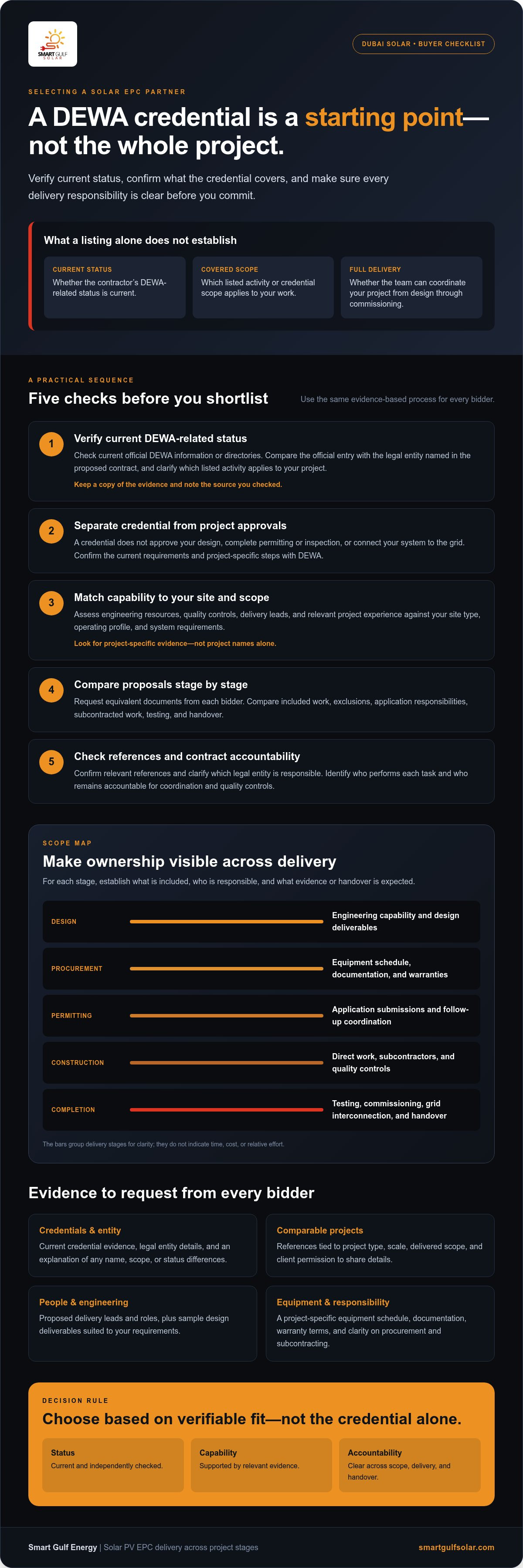
Use the same sequence for every bidder. It turns an initial search for a DEWA approved solar contractor into a documented procurement decision based on current evidence and a proposal tailored to your project.
- Verify status. Check current official DEWA information and retain a dated record. Match the listed entity and scope to the company named in the proposed contract.
- Assess project fit. Compare the contractor’s engineering resources and relevant experience with your site, operating needs, and proposed system scope.
- Compare scope. Confirm who owns design, procurement, application submissions, coordination, construction, testing, and handover. List exclusions and client dependencies.
- Check references. Request comparable project examples, confirm the work performed and its relevance, and seek permission to contact the reference where appropriate.
- Review the contract. Check responsibilities, milestones, acceptance definitions, warranties, change procedures, and closeout documents before selecting a preferred bidder.
Require current official evidence and a project-specific proposal before shortlisting a preferred bidder. If a DEWA requirement, approval dependency, or compliance claim is unclear, request a written explanation and verify the point against current DEWA guidance.
Pre-contract due diligence for solar EPC buyers
Confirm the exact contracting entity, evidence of applicable insurance, named project contacts, and an escalation route. Read payment milestones alongside the work they represent. Check how the contract defines completion, warranties, commissioning records, operating documents, and handover responsibilities. Specify the closeout package rather than leaving it to assumption.
Red flags that warrant follow-up
Pause if a contractor’s status cannot be independently verified, the legal name differs across documents, or permitting tasks have no named owner. Vague exclusions and unsupported performance guarantees also need clarification. Ask for written evidence wherever the proposed scope, timing, compliance basis, or responsibility remains ambiguous. Resolve material gaps before signing.
Once your site requirements and shortlist criteria are clear, you can submit them for a solar EPC project scope and Smart Quote. Use the resulting proposal to assess fit and responsibilities, and verify credentials independently.
Choosing Smart Gulf Energy for DEWA-Connected Solar EPC Delivery
After comparing credentials, project fit, and contractual responsibilities, consider whether one delivery partner can coordinate the stages your solar project requires. Smart Gulf Energy describes its solar PV EPC work as covering project development from concept through engineering, procurement, construction, and commissioning. Its stated project scope also includes DEWA permitting and grid interconnection, subject to the responsibilities agreed for each contract.
Smart Gulf Energy is based in Dubai, and its company information states that it has operated since 2005. Verify these details, along with any project references or credentials, before using them as evidence in a procurement decision. Do not assume the company is currently listed as a DEWA approved solar contractor. Independently check current DEWA or Shams Dubai records and confirm the exact status and scope that apply.
What Smart Gulf Energy can bring to an EPC project
A coordinated EPC scope can connect concept development, engineering, equipment procurement, construction, and commissioning under defined project responsibilities. For a DEWA-connected project, clarify in writing whether DEWA-related document preparation, submissions, responses, and grid interconnection coordination are included. Confirm who owns each task, what information the client must provide, and which approvals or connection milestones depend on DEWA review.
Request a project-specific proposal rather than relying on a general service description. It should set out deliverables, assumptions, exclusions, decision points, and handover records. Review references and supporting evidence for relevance to your site and scope, and use them only when the details are verified and approved for publication.
Move from contractor shortlist to project scope
Prepare the information that lets a contractor assess the project clearly:
- Site location and available site or building details.
- Electricity load information and operating profile.
- Project objectives, preferred scope, and known constraints.
- Decision requirements and target procurement milestones.
Use these inputs to compare the proposed scope and assumptions, then verify current DEWA-related status independently before appointment. A project enquiry should establish what is known, what needs assessment, and which responsibilities each party would accept. It should not be treated as evidence of approval or a commitment to a particular project outcome.
For project scoping, share your requirements with Smart Gulf Energy and request a proposal that defines the EPC scope and responsibilities for your Dubai solar project.
Turn Your Solar Shortlist Into a Defined Project Scope
A sound contractor decision rests on three checks: confirm current DEWA-related status through official information, match technical evidence to your project, and compare proposals by assigned responsibilities and deliverables. A DEWA approved solar contractor credential is a starting point, not proof that your design has approval or your system is ready for grid connection.
Smart Gulf Energy describes its solar EPC scope across engineering, procurement, construction, and commissioning, with a Dubai base. The company states that it has operated since 2005. Verify this history, current DEWA or Shams Dubai status, and any project references independently before relying on them in your selection.
Have your site details, load information, project objectives, and decision requirements ready. Then request a project-specific scope that identifies assumptions, responsibilities, and approval dependencies. Share your project requirements with Smart Gulf Energy to begin a scoping discussion. Make your next step a documented one, with a clear basis for selecting your solar EPC partner.
Frequently Asked Questions
How can I verify whether a solar contractor is DEWA approved?
Check the contractor against DEWA’s current official information or directory, then confirm the exact legal entity and listed scope. Ask the company for documentary evidence, but verify it independently rather than relying on a certificate, logo, or screenshot alone. Record the source and access date. If the listing uses different terminology or does not clearly cover the proposed work, ask DEWA to clarify before appointing the contractor.
Is a DEWA-approved contractor required for every solar project in Dubai?
For a PV system intended to connect to DEWA’s grid, check current Shams Dubai guidance, as DEWA-enrolled solar consultants and contractors are authorized to design and install these systems. Do not assume the same requirement applies to every project configuration, such as a standalone system that is not grid-connected. Confirm the project category and applicable requirements directly with DEWA before selecting a contractor or finalizing a scope.
What should I check before hiring a DEWA approved solar contractor?
Confirm current official status, then assess whether the contractor’s technical resources and relevant project references fit your site and system scope. Compare the proposed EPC stages, including design, procurement, DEWA coordination, construction, testing, and handover. Check equipment documentation, quality controls, exclusions, warranties, and responsibility for submissions or subcontracted work. Ask for a project-specific proposal with named contacts, deliverables, and clear acceptance points before signing.
Can a solar EPC contractor handle DEWA permits and grid connection?
An EPC contractor may take responsibility for DEWA-related permitting coordination and grid interconnection if those tasks are included in the agreed contract scope. Ask who prepares and submits each document, tracks responses, manages revisions, and coordinates outstanding requirements. Confirm current application steps with DEWA. A contractor’s involvement does not guarantee approval or connection, and the proposal should identify dependencies on DEWA review and any actions required from you.
What documents should a solar contractor provide before appointment?
Request evidence of current DEWA-related status, legal company details, and a project-specific proposal. The proposal should define scope, exclusions, assumptions, application responsibilities, milestones, and handover requirements. Ask for sample design deliverables, an equipment schedule, relevant project references, and names of delivery leads. Review applicable insurance evidence, warranty terms, and procedures for changes or defects. Verify claims and references independently, and get unclear responsibilities confirmed in writing before appointment.
What happens if a contractor’s DEWA approval claim cannot be verified?
Treat the claim as unconfirmed, not as proof of misconduct, and pause the appointment process. Ask the contractor for current documentary evidence and an explanation of any mismatch in legal name, listed activity, or scope. Check the information through DEWA’s official channels. If you still cannot verify the status or its relevance to your project, seek written clarification from DEWA and do not rely on the claim when making your selection.
How do I compare solar EPC contractor quotations in Dubai?
Compare proposals using the same scope checklist, not just the headline description or total price. Set out design, equipment procurement, DEWA coordination, construction, testing, commissioning, and handover, then mark what each bidder includes or excludes. Compare milestone deliverables, acceptance criteria, payment stages, warranties, client dependencies, and subcontracted work. Clarify who owns applications and technical responses. A written comparison makes gaps visible and helps you assess accountability alongside commercial terms.


