

Could your warehouse roof support solar without disrupting the operation beneath it? For businesses evaluating solar energy for warehouses Dubai, the answer depends on more than roof area. Structural capacity, roof condition, usable space, electricity demand and grid connection all affect whether a system is practical.
Before committing to a project, you need a clear way to assess the facility, compare system configurations and plan installation around warehouse activity. A strong project plan considers the roof, electrical infrastructure and day-to-day operations together.
This guide sets out a practical assessment pathway. You’ll learn what to review on the roof, how to align a system with your load profile and operating schedule, and what to consider for grid connection in Dubai. It also explains how an EPC scope can take a project from concept and engineering through DEWA permitting, construction, testing, commissioning and grid interconnection. Smart Gulf Energy is a Dubai-based solar EPC contractor operating since 2005, coordinating these stages as part of a project pathway.
Key Takeaways
- Use roof records, structural information and usable-area checks to assess whether your warehouse is a viable solar site.
- Compare grid-connected PV, battery storage and off-grid configurations against your facility’s operating needs and electrical setup.
- Assess solar energy for warehouses Dubai by considering roof conditions, consumption patterns and grid connection together.
- Prepare bills, load data, roof documents, site access rules and operating constraints to support a clear project plan.
- A coordinated EPC pathway can take a project from concept and engineering through construction, commissioning and grid interconnection.
Is Solar Energy for Warehouses in Dubai a Practical Fit?
Solar energy for warehouses Dubai is best assessed as a site-engineered photovoltaic (PV) system designed around a facility’s electricity needs. A large roof may provide space for an array, but roof size alone doesn’t establish feasibility. Structural capacity, roof condition, electrical infrastructure, safe access and the timing of electricity use all influence the design.
Start with the building and its energy use, rather than assuming a standard system size. Engineers need to determine how much roof area can be used, how the building distributes power and when the facility consumes electricity. Dubai’s solar development provides useful context, including the Solar power in the United Arab Emirates, but a warehouse design depends on its own engineering assessment.
A warehouse is a suitable solar site when its usable roof, structural condition, electrical systems and load profile can support a safe, workable PV design.
What makes a Dubai warehouse different from a standard commercial roof?
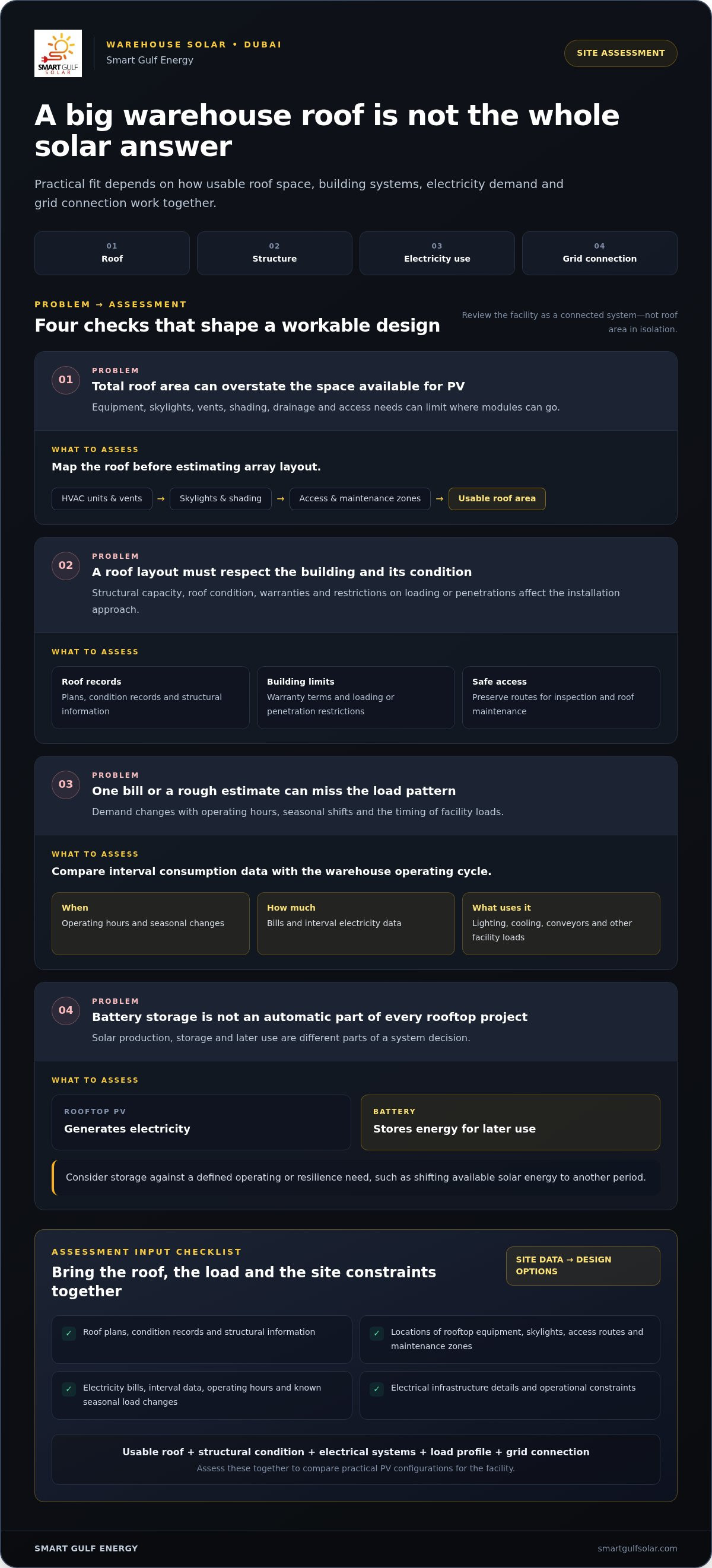
Warehouse roofs may have broad open areas alongside equipment, skylights and access routes. Review roof condition and available records before estimating the array layout. Locate HVAC units, vents, skylights, fire routes and maintenance access points, then map the remaining usable area. Roof warranties and restrictions on penetrations or loading also affect the installation approach.
Heat and dust make cleaning access and ongoing roof maintenance important parts of planning. The design must fit panels and supporting equipment around the roof’s existing use while preserving safe access for inspection and maintenance. A layout based only on total roof area can overstate the space available for PV.
Which warehouse electricity patterns support a solar assessment?
Review interval consumption data alongside operating hours and seasonal changes. Note when daytime demand comes from lighting, cooling, conveyors and other facility loads. This helps engineers assess how PV production may align with electricity use over a typical operating cycle, rather than sizing a system from a single bill or rough estimate.
Generation and savings depend on site data and project-specific analysis. Consumption patterns also help determine whether storage has a role. Rooftop PV generates electricity; a battery stores energy for later use. Assess storage against a defined operating or resilience need, such as shifting available solar energy to another period, rather than treating it as an automatic part of every rooftop project.
Before detailed design, gather the information needed for a useful initial assessment:
- Roof plans, condition records and structural information.
- Locations of rooftop equipment, skylights, access routes and maintenance zones.
- Electricity bills, interval data, operating hours and known seasonal load changes.
- Details of the facility’s electrical infrastructure and operational constraints.
Together, these inputs show whether the roof, building systems and demand profile can support a practical PV configuration. They also give engineers a sound basis for comparing design options.
How Do Engineers Design Solar Energy for a Dubai Warehouse?
Design turns site information into a coordinated electrical system. For solar energy for warehouses Dubai, engineers move from facility data and roof review to array layout, equipment selection, electrical integration and grid interface. Each decision must reflect the building’s physical limits and how the warehouse operates.
Warehouse PV capacity must match both site constraints and demand data. The goal isn’t to fill every available roof section. It’s to develop a workable layout and electrical design based on usable space, the facility’s consumption profile and its operating requirements.
How do roof and structural assessments shape the system layout?
Engineers review available structural information and arrange an assessment appropriate to the building and proposed design. They map shading, drainage, skylights, plant equipment and roof access before positioning modules. The layout must preserve maintenance routes and avoid obstructing normal roof operations. Some sections may need to remain clear rather than forcing a uniform array across the entire roof.
How should the design account for warehouse electrical demand?
Facility consumption data helps engineers compare demand patterns with expected solar generation. They identify suitable connection points and assess how the PV system can integrate with existing electrical infrastructure. A facility with steady daytime use presents a different design case from one with major shifts between operating periods, so capacity and connection planning should follow site-specific analysis.
Monitoring provides information about system operation after commissioning. Facility teams can use it to observe generation and identify when performance needs review, but it doesn’t guarantee a particular level of savings. Outcomes depend on the final system, actual site conditions and electricity use.
How do components and grid connection come together?
Inverter selection follows the planned array and electrical architecture. Engineers consider how the equipment will convert PV output and connect it to the facility system, while protection design supports safe electrical integration. The design also accounts for the grid interface and project interconnection requirements. Components should work together as a system, rather than being selected in isolation.
A practical design process moves through connected stages:
- Review facility plans, electrical records, consumption data and operating constraints.
- Assess structural information and map roof geometry, shading, access and obstructions.
- Develop an array layout that respects roof use and maintenance needs.
- Compare the design with the facility load profile and identify integration points.
- Coordinate equipment, protection, monitoring and grid-interface design.
This sequence gives owners a clear basis for reviewing design decisions before construction planning advances. Smart Gulf Energy coordinates solar PV EPC projects from concept and engineering through grid interconnection. Explore solar PV EPC project planning as part of a warehouse-specific design pathway.
Which Warehouse Solar Configuration Fits Your Roof and Operations?
The right configuration depends on the warehouse’s grid connection and what the solar system needs to do. For solar energy for warehouses Dubai, compare options against the facility’s operating priorities, electrical infrastructure and intended use of generated power. Configuration is a design decision, not simply a choice of equipment.
| Configuration | Grid relationship | Potential operating use | Infrastructure and design considerations |
|---|---|---|---|
| Grid-connected PV | Remains connected to the utility grid. | Uses solar generation alongside grid-supplied electricity. | Requires coordinated electrical integration and a design aligned with applicable grid and export requirements. |
| PV with battery storage | Combines solar and storage with a grid connection, subject to the system design. | Can be assessed for defined backup, load-shifting or peak-management objectives. | Adds storage equipment and control considerations. Sizing must reflect load data and operating priorities. |
| Off-grid configuration | Designed to operate independently of the utility grid. | May suit a facility with a specific need for independent supply, assessed against its actual operating requirements. | Requires careful planning around energy availability, loads and continuity needs. The system design depends closely on the facility’s full operating profile. |
When is grid-connected rooftop solar the relevant configuration?
Grid-connected PV is the starting point when the warehouse will remain connected to the utility and use solar as part of its electricity supply. The design must account for the site’s electrical connection and applicable grid requirements. Export arrangements depend on those requirements and the project design, so don’t assume how surplus generation will be handled before the grid interface is assessed.
When should a warehouse assess solar with battery storage?
Consider a battery when the facility has a defined objective, such as supplying selected loads during an interruption, shifting energy use or managing peaks. Battery sizing depends on load data, operating priorities and technical assessment. It isn’t a default addition to rooftop PV. For more on storage applications and design considerations, see the commercial battery energy storage system guide.
Off-grid systems require a different level of operational planning. Engineers need to understand which loads must run, when they operate and how the design will address periods when solar generation doesn’t match demand. The facility’s continuity needs are central to this assessment, rather than a simple equipment variation.
Use these questions to narrow the options:
- Will the warehouse stay connected to the utility grid?
- Is there a specific backup, load-shifting or peak-management objective?
- Does the facility require independent operation, and which loads must remain available?
Answering these questions helps define the configuration for detailed engineering. Next, plan the project pathway, including design, approvals, construction and commissioning.
How to Plan a Warehouse Solar Project in Dubai Step by Step
A clear project sequence keeps technical decisions, authority coordination and warehouse operations aligned. For solar energy for warehouses Dubai, start with reliable facility records, then move through assessment, design, approvals, construction and commissioning. Coordinate grid connection and permitting as project workstreams, with requirements considered for the specific project.
What information should a warehouse prepare for initial project planning?
Bring together electricity bills, available interval data, single-line diagrams and existing electrical records. Add roof drawings, structural documents, rooftop equipment locations and known maintenance restrictions. Document shifts, critical loads, expansion plans, site access rules and safety procedures. A complete information pack helps shape the assessment around actual facility conditions.
From there, the work advances in sequence:
- Collect facility data. The owner provides energy records, operating schedules, roof documentation and known site constraints.
- Assess the site. Review roof and structural information, electrical infrastructure, access conditions and operational requirements.
- Develop the design. Engineering translates facility data into a PV layout, electrical design and grid-interface plan matched to the warehouse.
- Coordinate approvals. Identify and manage relevant Dubai permitting and grid-connection workstreams. Account for authority requirements in the project plan.
- Plan procurement and construction. Confirm the work sequence, site access, work zones, lifting arrangements and safety controls with facility management.
- Test and commission. Include system testing, commissioning and grid interconnection in the project plan, and coordinate responsibilities before site work begins.
How can construction be coordinated with warehouse operations?
Plan construction around the facility’s movement of people, goods and equipment. Define access routes, lifting areas and work zones, then coordinate the installation sequence with facility management and relevant project stakeholders. Share operating constraints early, including restricted areas and critical activities. This gives the team a practical basis for managing work on an active site.
Keep commissioning in view from the start. Testing, handover activities and grid interconnection need a place in the project sequence, not a last-minute slot after installation. A defined EPC scope can connect engineering, procurement, construction and commissioning into one coordinated pathway. For a broader view of this process, consult the solar EPC contractor Dubai engineering guide.
Use a structured project plan to connect warehouse records, design decisions and on-site coordination. Plan your warehouse solar EPC project with a scope that covers engineering through commissioning.
How Smart Gulf Energy Delivers Warehouse Solar from Assessment to Commissioning
Warehouse solar needs a coordinated project pathway. Smart Gulf Energy is a Dubai-based solar EPC contractor operating since 2005, providing services from concept development through engineering, procurement, construction, testing and commissioning. For solar energy for warehouses Dubai, the technical scope is shaped around the facility, its electrical infrastructure and the way it operates.
What does end-to-end warehouse solar EPC include?
The work begins by translating the warehouse’s objectives and available site information into a project concept. Engineering develops the facility-specific design, including the PV arrangement and electrical integration. Procurement and construction follow the project scope, with testing and commissioning completing the delivery sequence.
Permitting and grid interconnection are coordinated parts of the project, not details to leave until installation is under way. Smart Gulf Energy’s solar EPC scope includes DEWA permitting and grid interconnection, with project requirements addressed during planning. This connects the work from initial concept through construction, testing and preparation for the grid interface.
Every warehouse has its own roof conditions, electrical arrangements and operating needs. Technical design and delivery details are tailored to the facility, so decisions reflect its records and constraints rather than a generic template. The EPC pathway keeps engineering, procurement, construction and commissioning connected as the project advances.
What should a warehouse owner expect from the first project discussion?
The first discussion should establish what the facility needs from solar and what information is available for assessment. Share the warehouse’s objectives, electricity bills or load data, roof conditions and operational constraints. Details such as shifts, restricted work areas, critical loads or planned facility changes can help define the project scope.
These inputs inform the next engineering steps. The project team can identify which records need review, define the assessment work and develop a scope around the building and its electrical systems. Providing clear information early helps keep decisions grounded in actual site conditions. Savings and project timing depend on project-specific analysis.
Smart Gulf Energy coordinates projects through concept, engineering, procurement, DEWA permitting, construction, testing, commissioning and grid interconnection. For warehouse owners, this provides a connected delivery pathway that carries facility requirements through each stage.
Share your facility objectives, energy data and roof information to begin a project discussion. Contact Smart Gulf Energy about your warehouse solar project.
Set Your Warehouse Solar Project in Motion
Turn your facility’s priorities into a practical project brief. Align the people responsible for energy, building operations and investment decisions around the outcomes the site needs. This shared direction keeps technical planning connected to business requirements from the outset.
For solar energy for warehouses Dubai, identify what information your team can assemble and which questions need engineering input. A focused discussion can clarify priorities, surface operational constraints and establish what to assess next. It also gives stakeholders a common basis for moving from early consideration to a defined scope.
Smart Gulf Energy brings warehouse requirements into a coordinated EPC project pathway covering engineering, procurement, construction, commissioning, DEWA permitting and grid interconnection. Share your facility objectives and available site information to begin a project discussion.
Start planning your warehouse solar project. A clear first step helps your team move forward with a grounded project brief.
Frequently Asked Questions
Can solar panels be installed on an existing warehouse roof?
Yes, an existing roof can support solar if its condition and structural capacity suit the proposed system. Consider timing too: if the roof is nearing planned repairs or replacement, coordinate that work with installation to avoid removing or disturbing a new array later. Roof warranty terms, mounting methods and restrictions on roof penetrations also affect the installation plan.
Does a warehouse need battery storage with rooftop solar?
No. A warehouse can use rooftop PV without a battery when storage isn’t needed for its operating objectives. Consider batteries if the facility needs backup for selected equipment or wants to shift solar energy to another period. For example, a site may prioritise keeping specific control or communications equipment running. Battery design must account for which loads matter and how they operate.
Will warehouse solar work during a Dubai power outage?
Not necessarily. A standard grid-connected solar system generally disconnects during a utility outage, so it doesn’t continue supplying the warehouse simply because sunlight is available. Continued power requires a system designed for backup operation, typically with storage and suitable controls. The design must identify which circuits need supply and account for their demand. Confirm the intended outage response during system design.
Can solar be installed on a leased warehouse?
It can be considered, but the building owner and tenant need to align on access, roof rights and responsibility for the installation. Review the lease provisions and agree who will manage roof work, maintenance access and changes to the building. Also consider the lease term against the project’s intended operating period. Early coordination helps resolve these practical issues before detailed design proceeds.
How often do solar panels on a Dubai warehouse need cleaning?
There isn’t one cleaning interval that suits every warehouse. Dust accumulation, nearby site activity, roof access and observed system performance all influence when cleaning is appropriate. Use monitoring data and visual inspections to identify changes, then plan safe cleaning in line with the system’s maintenance guidance. Avoid walking on modules or improvising cleaning methods, since unsafe access can damage equipment or create roof hazards.
What information is needed to assess warehouse solar in Dubai?
An initial assessment of solar energy for warehouses Dubai benefits from recent electricity bills and available interval consumption data, plus operating hours and details of critical equipment. Provide roof plans, structural records, electrical diagrams and notes on rooftop plant or access limits. Also share shift patterns, planned expansions and site safety procedures. These records help engineers focus the assessment on the facility’s actual conditions.


